


Japanese Emotion Words: How to Express Happy, Sad, Worried, Angry & More
How do you express emotions in Japanese when you feel happy, sad, worried, angry, or embarrassed?There is often more than one possible word, and each expression can carry a different nuance. This guide introduces common Japanese emotion words and helps you choose expressions that fit the feeling and situation.
Written by Chiho Kamioka ·
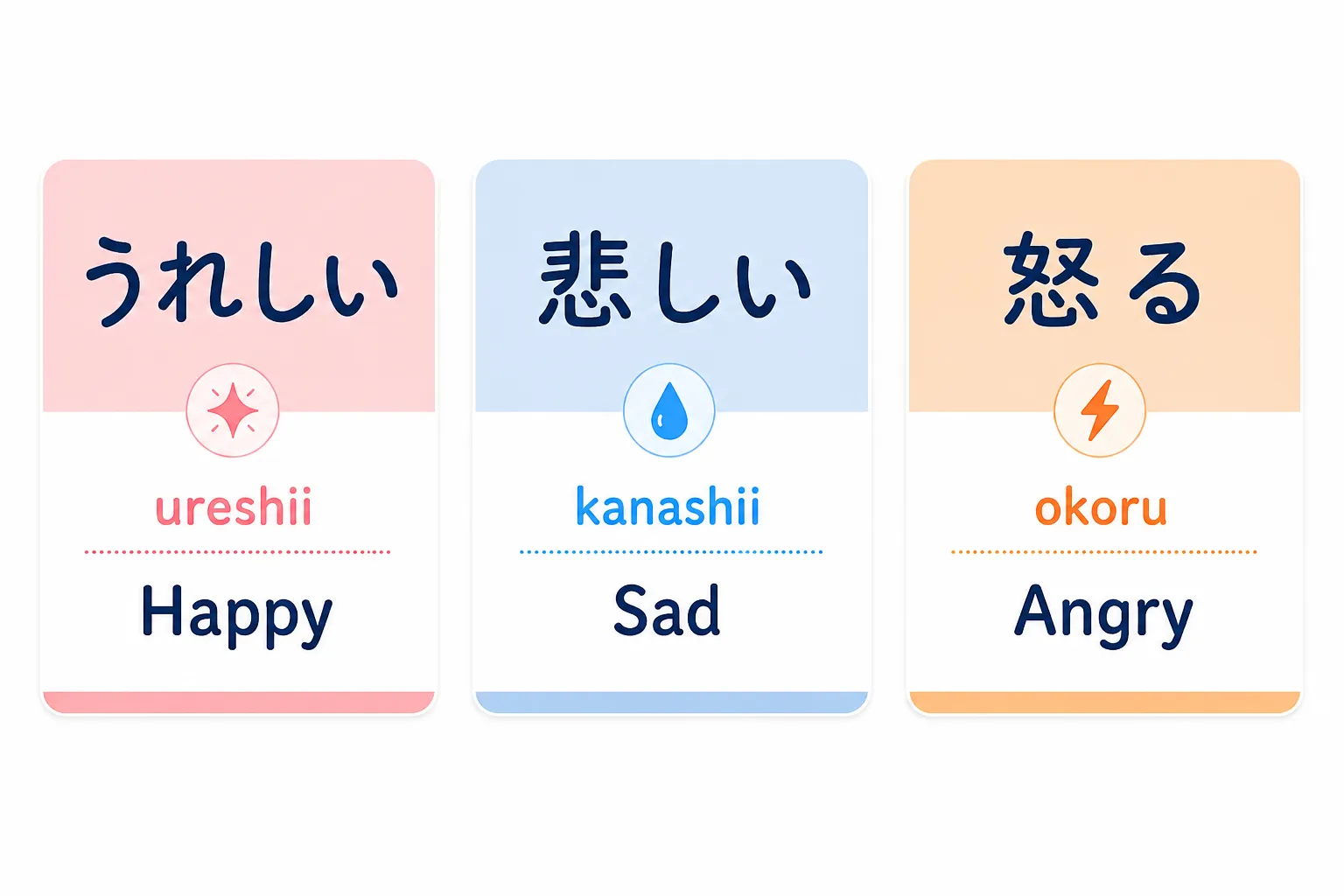
Japanese Emotion Words: Quick Guide
Here are some common Japanese words for feelings and emotions. The English translations are useful as a starting point, but the best Japanese word often depends on what caused the feeling and the situation you are describing.
| Feeling | Japanese | Romaji | Basic Nuance |
|---|---|---|---|
| Happy / Glad | うれしい | ureshii | Happy because something good happened |
| Fun / Enjoyable | 楽しい | tanoshii | Enjoying an activity or experience |
| Excited | わくわくする | wakuwaku suru | Positive excitement about something coming |
| Sad | 悲しい | kanashii | General sadness |
| Lonely / Missing Someone | 寂しい / さみしい | sabishii / samishii | Loneliness or missing someone |
| Bittersweet | 切ない | setsunai | A bittersweet or heart-aching feeling |
| Worried | 心配 | shinpai | Concern about a person, event, or result |
| Anxious / Uneasy | 不安 | fuan | Anxiety or uncertainty about what may happen |
| Nervous | 緊張する | kinchou suru | Feeling tense before an important situation |
| Angry | 怒る | okoru | To get angry or show anger |
| Irritated | イライラする | iraira suru | Ongoing irritation, impatience, or frustration |
| Embarrassed | 恥ずかしい | hazukashii | Personal embarrassment or self-consciousness |
| Awkward | 気まずい | kimazui | An uncomfortable social situation or atmosphere |
Why One English Feeling Can Have Several Japanese Words
Learning emotion vocabulary is not simply a matter of matching one English word with one Japanese word. Expressions that look similar in translation can describe different causes, situations, or shades of feeling.
The question is often not “What is the Japanese word for this emotion?” but “Which Japanese word fits this situation?”
For example, うれしい describes feeling happy or glad because something good happened, while 楽しい describes an activity or experience that is fun. In the same way, 心配 often focuses on a specific concern, while 不安 can describe a broader feeling of anxiety or uncertainty.
The guides below compare these differences in more detail and show how each expression appears in natural situations.
Happy does not always mean うれしい
Japanese uses different expressions for feeling glad, having fun, feeling relieved, looking forward to something, or being satisfied. Useful words include うれしい, 楽しい, 安心する, ほっとする, わくわくする, and 満足する.
悲しい is only one kind of sadness
Use 悲しい for general sadness, 寂しい / さみしい for loneliness or missing someone, and 切ない for a bittersweet or heart-aching feeling. Other expressions such as つらい, 苦しい, and 残念 describe different kinds of emotional pain or disappointment.
Sad in Japanese: Kanashii, Sabishii, Tsurai, Setsunai, and More →
心配, 不安, and 緊張 describe different feelings
心配 is often used for a specific concern, while 不安 describes anxiety or uncertainty. 緊張する is useful before an exam, interview, presentation, or other situation where you feel pressure. You may also hear ドキドキする for a pounding heart and そわそわする for restless nervousness.
Choose an anger word based on the cause and strength
怒る is a common word for becoming angry or showing anger. 腹が立つ focuses on the anger you feel inside, while イライラする describes ongoing irritation or impatience. Stronger casual expressions such as むかつく need more care, while 悔しい is often used for frustration after losing, failing, or missing a goal.
恥ずかしい and 気まずい are not the same feeling
恥ずかしい focuses on your own embarrassment or self-consciousness, while 気まずい describes an awkward interaction or atmosphere. 照れくさい is often softer and can describe feeling bashful after praise or positive attention, while 居心地が悪い describes feeling uncomfortable or out of place.
How to Say “Embarrassed” and “Awkward” in Japanese: Hazukashii, Kimazui, and More →
How to Choose the Right Japanese Emotion Word
When two Japanese expressions have similar English translations, think about the situation rather than trying to memorize one fixed translation.
What caused the feeling?
Good news, loneliness, uncertainty, a stressful delay, or an awkward interaction may call for different words even when the English translation looks similar.
What kind of feeling is it?
Ask whether you are describing happiness, enjoyment, relief, anxiety, irritation, embarrassment, or another more specific emotional state.
How strong and casual should it sound?
Some expressions are common and neutral, while others are casual, emotional, or strong. The person you are talking to also matters.
The more you connect an emotion word with a real situation, the easier it becomes to choose naturally in conversation.
Practice Expressing Your Feelings in Japanese
Knowing the meaning of an emotion word is the first step. In real conversation, you also need to choose an expression that fits the situation and the person you are talking to. In Japonin’s live online lessons, you can practice using Japanese vocabulary naturally in everyday conversation with experienced Japanese teachers.

Japanese Emotion Words FAQ
Since 2006, Japonin has helped over 6,000 learners worldwide study Japanese online with support from our experienced Japanese language teachers.

Written by Chiho Kamioka Founder of Japonin
Learners often know the basic English meaning of a Japanese emotion word but are unsure which expression fits a real situation. I created this series to compare common words for feelings and show the differences through everyday examples, so learners can choose expressions with more confidence.
Ready to express yourself in Japanese?
Study Japanese with experienced teachers at Japonin.
Try two 50-minute live lessons and practice expressing yourself naturally in Japanese.