


Ichiou vs. Toriaezu (一応 vs. とりあえず): What’s the Difference?
What is the difference between 一応 (ichiou / ichio) and とりあえず (toriaezu) in Japanese?
If you have seen these words translated similarly as "for now," this guide will clarify how 一応 and とりあえず actually sound to native speakers.
Updated: April 19, 2026
Quick Definition
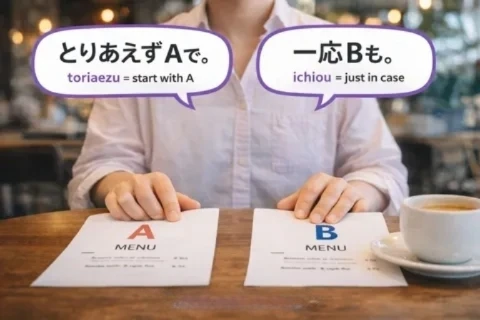
In Japanese, 一応 (ichio or ichiou) and とりあえず (toriaezu) are both sometimes translated as “for now,” but they do not mean the same thing.
If you want to understand the difference between ichiou and toriaezu, the key is this: とりあえず usually means “let’s start with this for now,” while 一応 suggests “just in case,” “at least,” or “technically.”
To use them naturally, you need to look at the situation, the speaker’s intention, and whether the speaker is trying to move forward or leave room.
Why These Two Words Feel Similar at First
Many learners first encounter 一応 and とりあえず through simple translations such as “for now,” so they may seem similar at first. However, that simple explanation often becomes confusing in real Japanese conversation.
Why? Because these two expressions do not simply describe time. They express attitude. They show how a speaker is positioning themselves toward a decision, an action, or the possibility of a mistake.
That is why learners often understand the basic translation, but still feel unsure when native speakers use these words naturally.
Why Japanese Uses “Provisional” Language
In English-speaking contexts, people often value clear answers and firm decisions. In Japanese, however, saying something too clearly or too early can sometimes create unnecessary pressure.
Instead of fixing everything immediately, speakers often leave a little space. That space allows for adjustment, protects relationships, and keeps the conversation moving without unnecessary tension.
Words like 一応 and とりあえず exist because Japanese speakers often prefer not to present something as completely final when it may still change.
This means these are not just vocabulary items.They reflect a broader communication style that moves carefully, leaves room, and avoids forcing certainty too early.
とりあえず (Toriaezu): Moving Before Deciding
In real conversation, とりあえず often appears when people want to avoid getting stuck. It allows a conversation or decision to move forward, even when everything is not fully settled.
Toriaezu is the word of action. It lets people begin before everything is decided. Instead of waiting for the ideal answer, it simply means, “This is enough to get started.”
1) Ordering at a Restaurant
When a group sits down, instead of waiting for everyone to read the whole menu, someone may say:
「とりあえずビールで!」 (toriaezu biiru de!)
“Let’s start with beer while we decide on the rest.”
The point is not that beer is the final choice. The point is to start the process and keep the group moving.
2) Taking the First Step
If you are unsure how to approach a big problem, you might say:
「とりあえずやってみます。」 (toriaezu yattemimasu.)
“I’ll give it a try for now and see what happens.”
Here, とりあえず reduces the pressure to find the perfect answer before taking action.
3) Keeping a Meeting Moving
In a meeting, people may not agree on the final plan yet, but someone may say:
「とりあえずこの案で進めましょう。」
“For now, let’s proceed with this proposal.”
This does not mean the proposal is ideal. It simply means it is good enough to move forward at this stage.
一応 (Ichiou): Leaving Room and Softening Certainty
一応 often feels softer and more cautious. It is used when a speaker wants to say something is true, done, or acceptable, but without sounding too definite.
Ichiou leaves a little room. It softens a statement and signals that something is probably fine, but not necessarily perfect. It can also suggest modesty or a sense of “just in case.”
1) The “Just in Case” Meaning
Even if the 天気 looks fine, you might take an 傘:
「一応、傘を持っていきます。」 (ichiou, kasa o motte ikimasu.)
“I’ll take an umbrella, just in case.”
The weather may look fine, but you are preparing for the possibility that it may not be.
2) The “Modesty Filter”
If you finish a 仕事 but want to avoid sounding overconfident:
「一応、終わりました。」 (ichiou, owarimashita.)
“It’s finished, at least for now.”
This often implies, “I have done it, but please check,” or “I believe it is done, but I am not claiming perfection.”
3) Meeting a Minimum Requirement
Suppose someone asks whether you studied for a test. You may answer:
「一応、勉強しました。」
“I studied, at least to some extent.”
This is very different from a confident “Yes, I studied thoroughly.” It suggests that the minimum has been done, but expectations should remain moderate.
The Real Difference: How Native Speakers Think
The difference between とりあえず and 一応 is not just about meaning. It reflects how the speaker thinks and what they are trying to avoid saying.
In short: とりあえず helps people move forward, while 一応 helps people leave room.
Common Mistakes to Avoid
Because both expressions are often translated as “for now,” learners sometimes assume they are interchangeable. In real Japanese, that can lead to awkwardness or misunderstanding.
Here are three common situations where this misunderstanding appears in real conversation.
Case 1: 「一応、終わりました」 in Business
A learner may think this sounds polite because it feels soft. However, to a Japanese manager, it may sound like:
- “There may still be mistakes.”
- “I am not fully confident.”
- “Please do not rely on this completely yet.”
That may be fine in some situations, but if the work really is complete, 「終わりました」 is clearer and stronger.
Case 2: 「とりあえずお願いします」 to a Client
Among friends or coworkers, this may sound practical. But to a 顧客, it can sound too casual or even dismissive, as if the matter is not being treated as important.
In formal business communication, it is usually better to say exactly what you want instead of using とりあえず.
Case 3: Mishearing Modesty as Weakness
When Japanese speakers say 「一応、勉強しました」, they may actually have studied quite seriously. But they are avoiding sounding arrogant. A non-native listener may misunderstand this and assume the speaker did very little.
This is one reason literal translation often fails. The hidden social meaning matters just as much as the grammar itself.
Remember: とりあえず moves the situation forward, while 一応 leaves room and softens certainty.
Mini Quiz
Try these short questions to check if you can feel the difference between とりあえず and 一応.
Q1. At a meeting, the team has not finished discussing everything, but you want to start with the current idea. Which fits better?
「( )この案で進めましょう。」
Show Answer
Answer: とりあえず
Because you want to move forward before everything is fully decided.
Q2. You are not fully sure whether it will rain, but you decide to take an umbrella just in case. Which fits better?
「( )、傘を持っていきます。」
Show Answer
Answer: 一応
Because you are leaving room for uncertainty and preparing just in case.
Q3. You finished a task, but you do not want to sound too confident yet. Which fits better?
「( )、終わりました。」
Show Answer
Answer: 一応
Because you want to soften the statement and leave room for checking.
FAQ
Do とりあえず (toriaezu) and 一応 (ichiou) mean the same thing?
Not exactly. They may overlap in translation, but they serve different roles. とりあえず (toriaezu) is about beginning an action before everything is decided, while 一応 (ichiou) is about leaving room and softening certainty.
Is 一応 (ichiou) polite?
It often sounds modest and careful, which is usually positive. However, in business situations, overusing it may make you sound uncertain or not fully confident.
Is とりあえず (toriaezu) rude?
Not in casual conversation. It is very common among friends and coworkers. However, in formal situations, it can sound too casual or slightly rough, so more precise wording is often better.
Can I translate both as “for now”?
You can, but that translation hides the nuance. The difference is not only about time. It is about whether the speaker is trying to move forward or avoid sounding too definite.
Can I use 一応 and とりあえず in business Japanese?
Yes, but carefully. 一応 may sound modest, but it can also make you sound unsure. とりあえず is common in internal conversation, but it can sound too casual in formal business communication or when speaking to clients.
Practice with Japonin (JOI) Teachers
All Japonin (JOI) teachers are certified professionals with an average of over 15 years of teaching experience. In our group classes and private lessons, you can practice subtle expressions such as 一応 and とりあえず in real role-plays, from casual conversation and group discussions to workplace communication and business situations.

Learn with Japonin (JOI)
If you would like to practice expressions like 一応 and とりあえず in real communication, Japonin (JOI) offers a range of online Japanese lessons for different levels and goals.
- Conversation Classes (CEFR A1–C2) Practice natural Japanese expressions in everyday conversation, group discussion, and workplace communication.
- Business Japanese Practice subtle and context-based expressions that often appear in Japanese meetings, coordination, and customer communication.
- Survival Japanese Build confidence with practical expressions used in shops, restaurants, travel situations, and daily life in Japan.
- LRC Training Train your ear to catch nuance, context-based meaning, and natural responses in fast Japanese conversation.
Meet Our Conversation & Business Japanese Teachers Online

ISHIBASHI Kaori
- 20+ years of teaching experience
- Survival / Beginner / Intermediate / Advanced / Business Japanese

SOMEYA Sachiko
- 14+ years of teaching experience
- Beginner / Advanced / Expat support lessons

TAKASE Chiharu
- 16+ years of teaching experience
- Beginner to Advanced / JLPT N3–N2 Grammar
Ready to use “toriaezu” in real conversation?
Try two 50-minute live lessons with Japonin (JOI) teachers.
Practice natural phrases like toriaezu with real feedback.
Japonin Deep Dive / Conversation


Since 2006, Japonin (JOI) has provided online Japanese lessons to over 6,000 learners worldwide, guided by our team of qualified and experienced teachers.

Written by Chiho Kamioka Founder
Words like 一応 and とりあえず may seem small, but they reveal something important about how Japanese communication works. By paying attention not only to the words themselves but also to the speaker’s intention, learners can understand Japanese more naturally and respond with greater confidence.