


What Does 大丈夫 (Daijoubu / Daijobu) Mean? Yes, No, or “I’m Fine”?
A simple word like daijoubu can express reassurance, approval, or a polite refusal, depending on the situation and tone.
Learn how Japanese people really use daijoubu in everyday conversation and business settings, with essential patterns, examples, mini dialogues, and cultural insights you can apply right away.
Updated: April 17, 2026
Quick Definition
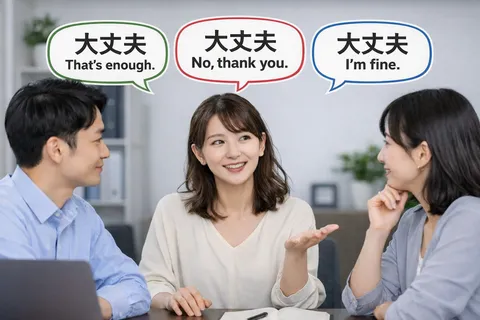
In Japanese, daijoubu (written as 大丈夫 and often spelled as daijobu) can mean “yes,” “no,” “I’m fine,” or “it’s okay,” depending on the situation and tone.
It is a flexible expression that does not always match one direct English word. In one situation, 大丈夫です can sound positive and reassuring. In another, it can work as a polite refusal.
To understand it correctly, you need to look at the question, the situation, and the speaker’s intention.
Use daijoubu to:
- say you are okay, safe, or not in trouble
- politely decline help, items, or offers
- respond carefully in business situations that require a more precise answer
Why “Daijoubu” (大丈夫) Feels So Confusing
In English, words like “yes,” “no,” “I’m fine,” and “that’s enough” are usually separate. In Japanese, however, 大丈夫 can cover all of these ideas. That is why learners often feel confused when they hear the same word used in different situations.
Japanese communication often focuses on the overall situation rather than a direct yes or no. Because of this, 大丈夫です often works as a context-based response.
- Maintain harmony: a softer answer often sounds more natural than a direct “no.”
- Avoid over-explaining: Japanese speakers do not always state the full reason directly.
- Let context do the work: the real meaning often comes from the question and situation.
Quick List – Main Meanings of Daijoubu in Real Life
- 大丈夫? (daijoubu?) – “Are you okay?” / “Is it okay?” / “Will it be all right?”
- 大丈夫です。 (daijoubu desu.) – “I’m fine.” / “It’s okay.” / “No problem.”
- 大丈夫です。 (in shops or offers) – “No, thank you.” / “I don’t need it.”
- もう大丈夫です。 (mou daijoubu desu.) – “I’m okay now.” / “That’s enough now.”
- たぶん大丈夫です。 (tabun daijoubu desu.) – “It will probably be okay.”
- 全然大丈夫です。 (zenzen daijoubu desu.) – “It’s totally fine.” / “No problem at all.”
How to Understand the Meaning of Daijoubu
The easiest way to understand 大丈夫です is to ask: What kind of question came before it? Use this guide to see the most natural meaning in each situation.
| Situation | Natural Daijoubu | How it feels / What it means |
|---|---|---|
| Someone asks if you are okay after a problem or accident |
大丈夫です。 もう大丈夫です。 |
Positive meaning. “I’m fine,” “I’m okay,” or “I’m okay now.” |
| A shop clerk offers you a bag, receipt, drink, or extra item |
大丈夫です。 結構です。 |
Polite refusal. Usually means “No, thank you,” or “I don’t need it.” |
| Someone offers help, and you do not need it |
大丈夫です。 ありがとうございます。大丈夫です。 |
Gentle refusal. “I’m okay, thank you.” Softer than a direct “no.” |
| Someone asks if a plan, time, or action is acceptable |
大丈夫です。 全然大丈夫です。 |
Approval or permission. “Yes, that’s fine,” or “No problem at all.” |
| Someone offers more food, drink, or support |
もう大丈夫です。 これで大丈夫です。 |
Means “That’s enough,” “I’m okay now,” or “I don’t need more.” |
| Business situation requiring a clear answer | 問題ございません。 差し支えございません。 結構でございます。 |
大丈夫です may sound vague. In formal situations, more precise wording is often better. |
If you first identify whether the speaker is accepting, refusing, or reassuring, the meaning of 大丈夫 becomes much easier to understand.
Daijoubu in Everyday Conversation
In daily Japanese, 大丈夫 can sound reassuring, approving, or politely refusing depending on the context.
1) 大丈夫です。(“I’m fine.” / “I’m okay.”)
A common response when someone checks on your condition
When someone asks whether you are okay physically, emotionally, or generally, 大丈夫です often has a straightforward positive meaning. In this case, it reassures the other person.
Example
(B falls on the stairs.)
A: 大丈夫ですか。
B: はい、大丈夫です。
“Are you okay?” → “Yes, I’m fine.”
2) 大丈夫です。(“No, thank you.”)
In shops, restaurants, and everyday service situations, 大丈夫です often means “No, thank you” or “I don’t need it.” Although it sounds positive, it often functions as a polite refusal.
Example
A: 袋はお付けしますか。
B: 大丈夫です。
“Would you like a bag?” → “No, thank you.”
A: レシートはご利用ですか。
B: 大丈夫です。
“Would you like a receipt?” → “No, thank you.”
A: お水はいかがですか。
B: 大丈夫です。
“Would you like some water?” → “No, thank you.”
A: 手伝いましょうか。
B: ありがとうございます。大丈夫です。
“Shall I help you?” → “Thank you, I’m okay.”
3) 全然大丈夫です。(“That’s totally fine.”)
全然大丈夫です makes the positive meaning of 大丈夫です stronger. It is often used to reassure someone warmly and clearly.
Example
A: 少し遅れても大丈夫ですか。
B: 全然大丈夫です。
“Would it be okay if I’m a little late?” → “Yes, that’s totally fine.”
A: こんな時間に連絡してしまって、すみません。
B: 全然大丈夫です。
“Sorry for contacting you this late.” → “It’s totally fine.”
A: 予定を変更しても大丈夫ですか。
B: 全然大丈夫です。
“Would it be okay to change the plan?” → “Yes, that’s completely fine.”
4) 大丈夫です。(“I’m okay now.” / “That’s enough.”)
大丈夫です is often used when you do not need more of something, or when help is no longer necessary. Depending on the situation, it can mean “I’m okay now,” “That’s enough,” or “You can stop now.”
Example
A: お飲み物のおかわりはいかがですか。
B: 大丈夫です。
“Would you like another drink?” → “No, I’m okay now.”
A: 荷物、持ちましょうか。
B: ありがとうございます。大丈夫です。
“Shall I carry your bag?” → “Thank you, but I’m okay now.”
A: もう少し説明しましょうか。
B: 大丈夫です。わかりました。
“Shall I explain a little more?” → “No, it’s okay. I understand.”
5) 大丈夫?(“Are you okay?” / “Is it okay?”)
大丈夫? is one of the most common everyday questions in Japanese. It can ask about someone’s condition, whether a plan is okay, or whether something is safe.
Examples
荷物、重くない? 大丈夫?
“Isn’t your bag heavy? Are you okay?”
明日10時でも大丈夫?
“Is 10:00 tomorrow okay for you?”
それ、食べても大丈夫?
“Is it okay to eat that?” / “Is that safe to eat?”
If you want to practice polite refusals in Japanese, our guide on the Soft NO is a helpful companion to understanding how 大丈夫です can sometimes mean “no.”
What to Say Instead of “Daijoubu” (大丈夫) in Business
In casual conversation, 大丈夫です is very common. In business, however, it can sound too vague, so more precise expressions are often better.
1) 問題ございません。– “There is no problem.”
A clearer and more professional version of “It’s okay”
When you want to approve something or reassure a client or colleague, 問題ございません is often better than 大丈夫です. It sounds more formal and leaves less room for misunderstanding.
Example
A: 納期が一日ずれても大丈夫でしょうか。
B: 問題ございません。
“Would it be okay if the delivery date shifts by one day?” → “There is no problem.”
2) 差し支えございません。– “That will be fine.” / “There is no inconvenience.”
A formal way to say something is acceptable
差し支えございません is useful when the question is about permission or whether something causes a problem. It sounds more formal and polished than 大丈夫です.
Example
A: こちらは英語で記載してもよろしいでしょうか。
B: はい、差し支えございません。
“Would it be alright if this were written in English?” → “Yes, that is perfectly fine.”
3) 結構です – “No, thank you.” / “That will be enough.”
A more explicit refusal than daijoubu
In some business contexts, if you clearly do not need something, 結構です can be more precise than 大丈夫です. However, it can also sound firm depending on tone, so it is not always the best choice in warm customer-facing communication.
Example
A: 追加で資料をお送りしましょうか。
B: いえ、今回は結構です。
“Shall I send some additional materials?” → “No, that won’t be necessary this time.”
Common Mistakes Learners Make
Because 大丈夫です sounds positive and friendly, learners sometimes assume it always means “yes.” In real-life Japanese, that can lead to misunderstandings. Here are three common mistakes to watch out for.
1) Thinking daijoubu always means “yes”
In many shop or service situations, 大丈夫です actually means “No, thank you.” Always check what kind of question came before it.
2) Using daijoubu in business when a clearer phrase is needed
In formal communication, 大丈夫です can sound vague. More precise expressions such as 問題ございません or 差し支えございません are often better.
3) Ignoring tone and timing
Tone matters a lot. A warm 大丈夫です can sound reassuring, while a short, flat one can sound like a firm refusal. Adding ありがとうございます can make it softer.
Remember: 大丈夫です is not a single fixed translation. Its meaning becomes clear only when you look at the question, situation, and tone together.
Where Daijoubu Fits Among Similar Japanese Expressions
The table below shows how 大丈夫 compares with other expressions that learners often confuse with it.
| Expression | Example | Impression | Typical use |
|---|---|---|---|
| 大丈夫です | “I’m fine.” / “No, thank you.” / “It’s okay.” | Flexible, natural, context-based | Daily conversation, shops, casual reassurance, light approval |
| いいえ | “No.” | Direct and clear; sometimes strong or formal | When a direct negative answer is needed |
| 結構です | “No, thank you.” / “That will be enough.” | More explicit than 大丈夫です; can sound firm | Refusing offers or extra items more clearly |
| ちょっと… | “That might be a bit difficult…” | Very soft, indirect refusal | Declining invitations or requests gently |
| 問題ございません | “There is no problem.” | Professional, precise, reassuring | Business communication and customer support |
Compared with these expressions, 大丈夫 is best understood as a flexible context word rather than a fixed translation.
Mini Quiz
Try these short questions to check how well you can read the meaning of 大丈夫です from context.
Q1. At a convenience store, the clerk asks, “袋はご利用ですか。” You reply, “大丈夫です。” What does your answer most naturally mean?
- Yes, I need a bag.
- No, I do not need a bag.
Show Answer
Answer: ②
In this kind of service situation, 大丈夫です usually means “No, thank you.”
Q2. Your friend trips and then asks, “私、変じゃなかった? 大丈夫?” You answer, “大丈夫だよ。” What does that mean?
- You are reassuring your friend that everything is okay.
- You are refusing your friend’s request.
Show Answer
Answer: ①
Here 大丈夫だよ means “It’s okay” or “You’re fine.”
Q3. A colleague says, “10分ほど遅れそうです。大丈夫でしょうか。” You reply, “全然大丈夫です。” What does your answer most naturally mean?
- No, that is not acceptable.
- Yes, that is completely fine.
Show Answer
Answer: ②
全然大丈夫です strongly reassures the other person that there is no problem.
Q4. At dinner, someone asks, “もう少し召し上がりますか。” You reply, “もう大丈夫です。” What is the safest understanding?
- You do not need more.
- You want a larger portion.
Show Answer
Answer: ①
もう大丈夫です usually means “That’s enough” or “I’m okay now.”
FAQ
Does daijoubu mean “yes” or “no”?
It can mean either one. If the question is about your condition or whether something is acceptable, 大丈夫です often means “yes” or “it is okay.” If the question is about whether you want an item, help, or extra service, it often means “no, thank you.”
Is daijoubu always polite?
大丈夫です is polite enough for many everyday situations, including shops, friends you are not close to, and casual workplace communication. However, in formal business situations, it may sound too broad or vague, so more precise expressions such as 問題ございません may be better.
What is the difference between daijoubu and kekkou desu?
大丈夫です is softer and more flexible. 結構です is more clearly used to mean “No, thank you” or “That will be enough,” but depending on tone it can sound firmer. In many daily situations, learners hear 大丈夫です more often.
As a non-native speaker, is it okay for me to use daijoubu?
Yes. In fact, learning how to use and understand 大丈夫 naturally is one of the best ways to sound more comfortable in real Japanese conversation. The key is to pay attention to context, not just vocabulary.
For smoother everyday interaction, you may also find it helpful to learn casual aizuchi used in real Japanese conversation .
Practice with Japonin (JOI) Teachers
All Japonin (JOI) teachers are certified professionals with an average of over 15 years of teaching experience. In our group classes and private lessons, you can practice daijoubu and other delicate expressions in real role-plays – from casual conversation and shop interactions to polite workplace communication and business situations.

Learn with Japonin (JOI)
If you would like to practice expressions like 大丈夫です (daijoubu desu) in real communication, Japonin (JOI) offers a range of online Japanese lessons for different levels and goals.
- Conversation Classes (CEFR A1–C2) Practice natural Japanese responses such as 大丈夫 (daijoubu) in everyday and workplace conversations.
- Business Japanese Practice vague and context-based expressions that often appear in Japanese meetings, coordination, and customer communication.
- Survival Japanese Use 大丈夫です naturally in shops, restaurants, travel situations, and everyday life in Japan.
- LRC Training Train your ear to catch context-based meanings and respond naturally in fast Japanese conversation.
Meet Our Conversation & Business Japanese Teachers Online

YOKOZUKA Noriko
- 21+ years of teaching experience
- Intermediate / Intermediate Grammar (JLPT N2) / JLPT N2 Kanji / Advanced Grammar (JLPT N1) | Private Lessons

HAYASHI Ayumi
- 13+ years of teaching experience
- Low Intermediate / Low Intermediate Grammar (JLPT N3) / Intermediate Grammar (JLPT N2) / Advanced Grammar (JLPT N1) | Private Lessons

YAMAMOTO Hiroshi - Business Japanese specialist
- 10+ years of teaching experience
- Beginner 2 Grammar (JLPT N4) / Low Intermediate Grammar (JLPT N3) / Intermediate Grammar (JLPT N2) / Advanced Grammar (JLPT N1) / Advanced / Business Japanese | Private Lessons
Ready to use “daijoubu” in real conversation?
Try two 50-minute live lessons with Japonin (JOI) teachers.
Practice natural phrases like daijobu with real feedback.
Japonin Deep Dive / Conversation


Since 2006, Japonin (JOI) has provided online Japanese lessons to over 6,000 learners worldwide, guided by our team of qualified and experienced teachers.

Written by Chiho Kamioka Founder
.Daijoubu is one of the most useful everyday words in Japanese, but it does not have just one fixed meaning. It can mean “I’m fine,” “It’s okay,” or even “No, thank you,” depending on the context. By paying attention to the question, the situation, and the speaker’s tone, you can understand it more naturally and use it with much more confidence.