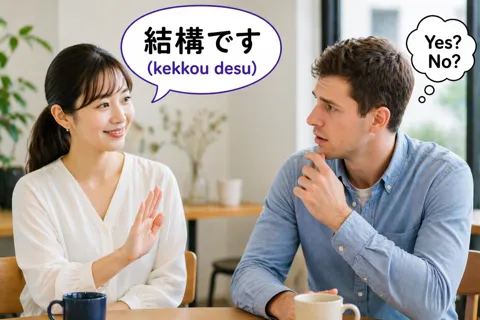
Japonin Deep Dive / Conversation & Business Japanese
What Does “Kekkou Desu” (結構です) Mean?
Do Japanese people always avoid saying “no” directly?
Not always. Sometimes Japanese speakers choose a clearer refusal, and one important expression is 結構けっこう です
This guide shows how 結構です (kekkou desu / kekko desu) works in everyday conversation and business Japanese, with key patterns, examples, mini dialogues, and cultural insight.
Audience: Upper-Beginner to Intermediate ⏱ 4–6 minUpdated: April 23, 2026
On this page
Why Direct “No” Is Often Softened in Japanese A Polite But Clear Refusal: 結構です (Kekkou Desu) When 結構です (Kekkou Desu) Means “No, Thank You” How Native Speakers Choose Their Words How to Soften “Kekkou Desu” FAQ Practice with Japonin (JOI) Teachers
Why Direct “No” Is Often Softened in Japanese
In English-speaking contexts, saying “no” clearly is often seen as efficient and honest. In Japanese, however, a direct refusal can sometimes sound more final or uncomfortable than necessary.
In many everyday situations, Japanese speakers often use softer expressions instead of rejecting something directly. Leaving a little space helps the conversation stay smooth, protects the relationship, and avoids making the other person lose face.
For example, expressions like ちょっと… (chotto...) are often used as a soft refusal, while 大丈夫だいじょうぶ です
We explore these expressions in more detail in our Deep Dive articles: What Does “Daijoubu” Mean in Japanese? and How to Say No Politely in Japanese (Soft No) .
A Polite But Clear Refusal: 結構です (Kekkou Desu)
However, Japanese does have expressions that can refuse something more clearly. One important example is 結構けっこう です
This expression can have different meanings depending on the context. It may mean “that is fine” in some situations and “I don’t need it” in others. In this Japonin Deep Dive, we focus on its refusal meaning and explore why it can sound polite while still feeling clear and final.
At first, 結構けっこう です
Grammatically, it is polite. Pragmatically, however, it can sound as if the decision is already closed.
In real conversation, then, 結構けっこう です
When 結構です (Kekkou Desu) Means “No, Thank You”
Here are some typical situations where 結構けっこう です
1) Refusing an Additional Service in a Shop
A staff member may ask:「当店とうてん のアプリにご登録とうろく なさいますか。」 “Would you like to register for our app?”
You may reply:「結構けっこう です “No, thank you.”
Here, the speaker is politely declining an additional service. The answer is clear, and the staff member can move on without needing to ask again.
2) Stopping Additional Help or Explanation
Someone may offer more support:「もう少すこ し説明せつめい しましょうか。」 “Shall I explain a little more?”
You may answer:「結構けっこう です “No, thank you. That will be enough.”
This is not just a soft reaction. It tells the other person that more explanation is unnecessary and the matter can stop there.
3) Declining in Business Communication
In a business setting, someone may propose a plan:「こちらのプランはいかがでしょうか。」 “How about this plan?”
A reply such as:「今回こんかい は結構けっこう です “We will pass this time.”
This makes the refusal clear. There may still be politeness around it, but the answer itself is not open.
How to Soften “Kekkou Desu”
Because 結構けっこう です
Japanese speakers often soften it by adding something before or after the phrase. This allows them to keep the refusal clear while still maintaining a polite and considerate tone.
1) Adding a soft opener
「申もう し訳わけ ないですが、結構けっこう です。」 “I’m sorry, but I’ll pass.” 「すみませんが、結構けっこう です。」 “Sorry, no thank you.”
2) Adding a soft closing
「また機会きかい があればお願ねが いします。」 “Maybe next time.” 「ありがとうございます。」 “Thank you.”
This balance is very natural in Japanese communication. The refusal itself stays clear, but the overall tone becomes softer and more considerate.
How Native Speakers Choose Their Words
The difference between ちょっと… , 大丈夫だいじょうぶ です結構けっこう です
ちょっと… (chotto...)Soft No
Internal voice
“I do not want to say no directly. Let me soften this.”
Core feeling
Avoid conflict and leave space
大丈夫だいじょうぶ です (daijoubu desu)Softer refusal
Internal voice
“I’m okay. I don’t need it, but I don’t want to say that too directly.”
Core feeling
A softer, less direct way to refuse
結構けっこう です (kekkou desu)Clear refusal
Internal voice
“I have decided. I will refuse politely, but clearly.”
Core feeling
Clear refusal without negotiation
In short: ちょっと… avoids saying no directly, 大丈夫だいじょうぶ です結構けっこう です
FAQ
Does 結構けっこう ですkekkou desu ) always mean “no”?
No. Kekkou desu can have different meanings depending on the context, tone, and situation. In some cases, it means “No, thank you,” while in others, it means “That is fine.”
Is 結構けっこう です
Not in itself. It is a polite expression. However, depending on the tone and relationship, it can sound cold, distant, or more final than softer alternatives.
Is 結構けっこう です大丈夫だいじょうぶ です
Usually yes. 大丈夫だいじょうぶ です結構けっこう です
Can I use 結構けっこう です
You can, but it may sound too formal or distant. In casual relationships, softer and more natural expressions are often preferred.
Can I use 結構けっこう です
Yes, especially when you need a polite but clear refusal. In sensitive situations, speakers often soften it by adding apology or relationship-focused language before or after the refusal.
Practice with Japonin (JOI) Teachers
All Japonin (JOI) teachers are certified professionals with an average of over 15 years of teaching experience . In our group classes and private lessons, you can practice subtle refusal expressions such as 結構けっこう です大丈夫だいじょうぶ ですちょっと… in real role-plays , from shops and daily life to workplace communication and business situations.
Learn with Japonin (JOI)
If you would like to practice expressions like 結構けっこう です
Conversation Classes (CEFR A1–C2) Practice natural Japanese responses in everyday conversation, including how to accept, soften, or clearly refuse something depending on context.
Business Japanese Practice subtle expressions used in meetings, client communication, and polite refusals in professional situations. Survival Japanese Build confidence with practical expressions used in shops, restaurants, transport, and daily life in Japan. LRC Training Train your ear to catch nuance, tone, and context-based meaning in natural Japanese conversation.
Meet Our Conversation & Business Japanese Teachers Online
OOSAWA Miki
14+ years of teaching experience
Beginner 1 / Beginner 2 / JLPT N4 Kanji / Low Intermediate / Low Intermediate Grammar (JLPT N3) | Private Lessons
▶ View Profile
YATABE Kumiko
14+ years of teaching experience
LRC (Listen → Repeat → Correct) | Private Lessons
▶ View Profile
TAKANE Yukiko
16+ years of teaching experience
Beginner 2 / Beginner 2 Grammar (JLPT N4) | Private Lessons
▶ View Profile
Ready to use “Kekkou desu” in real conversation?
Try two 50-minute live lessons with Japonin (JOI) teachers.kekkou desu with real feedback.
Try 2 Free Live Lessons
Japonin Deep Dive / Conversation
Conversation Japanese
Taihen (大変) Meaning in Japanese
Learn how
taihen can mean “difficult,” “serious,” or express empathy in natural Japanese conversation.
Conversation Japanese
Aizuchi in Japanese: Natural Listening Reactions
Learn how Japanese speakers show understanding and keep conversations flowing with natural listening responses.
Conversation & Business
Ichiou vs. Toriaezu: What’s the Difference?
See how Japanese speakers leave room, soften certainty, and move conversations forward with two small but important expressions.
Since 2006 , Japonin (JOI) has provided online Japanese lessons to over 6,000 learners worldwide , guided by our team of qualified and experienced teachers.
In this Japonin Deep Dive, we explored how kekkou desu can sound polite on the surface, yet still function as a clear and fairly firm refusal. By paying attention not only to the words themselves but also to how Japanese speakers signal their intentions, learners can understand Japanese more naturally and respond with greater confidence.