


JLPT N3 Study Guide: Kanji, Vocabulary & Grammar
JLPT N3 is where many learners meet the “intermediate wall.” This guide covers key N3 kanji, vocabulary, grammar, reading connectors, and a realistic study plan.
Written by Chiho Kamioka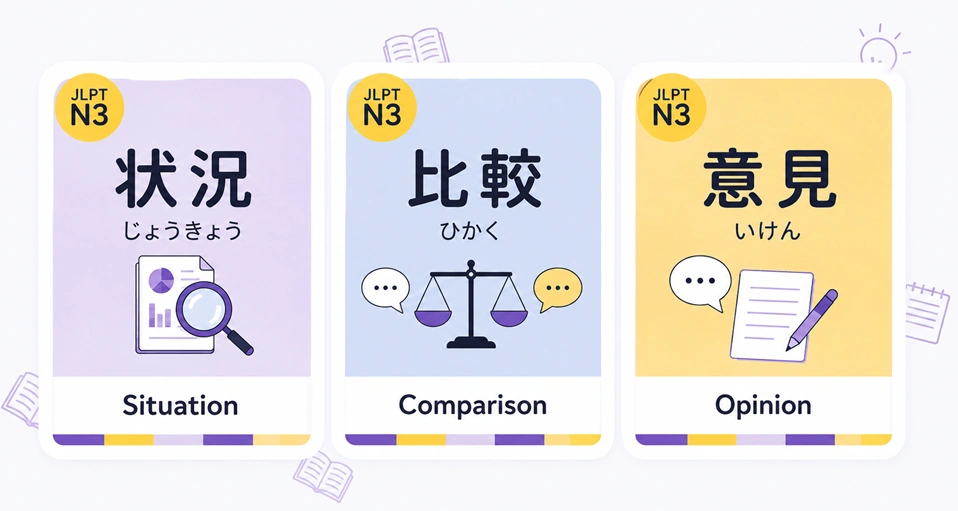
JLPT N3 at a Glance
- Level: Intermediate level between basic Japanese and advanced Japanese
- Kanji: About 650 characters
- Vocabulary: Around 3,500+ common words
- Grammar: Patterns for nuance, conditions, contrast, intention, and indirect expression
- Goal: Understand everyday Japanese in longer conversations and short written passages with some complexity
Note: Numbers are approximate study targets. The official JLPT does not publish exact kanji or vocabulary lists.
How Many Kanji Do You Need for JLPT N3?
Most JLPT N3 learners aim for around 650 kanji. At N3, the challenge is not simply memorizing more characters. You need to recognize kanji quickly inside longer words, phrases, announcements, emails, and reading passages.
Compared with N4, you will encounter more vocabulary made up of multiple kanji. For example, you may see words such as 状況 (situation), 関係 (relationship), 意見 (opinion), and 経験 (experience). Understanding these words will help you follow conversations, explanations, and reading passages more easily.
Common JLPT N3 Words by Category
JLPT N3 vocabulary becomes more abstract than N4. The categories below show common N3-style words for situations, reasons, opinions, relationships, changes, and social information.
Situations, Reasons & Conditions
場合 / 理由 / 条件 / 状況
Translation: case, reason, condition, situation
People, Feelings & Relationships
相手 / 気持ち / 気分 / 関係
Translation: other person, feeling, mood, relationship
Opinions, Ideas & Explanation
考え / 意味 / 表現 / 説明
Translation: idea, meaning, expression, explanation
Information, Society & Daily Life
情報 / 資料 / 生活 / 習慣
Translation: information, materials, daily life, custom
Change, Progress & Comparison
変化 / 進歩 / 増える / 比較
Translation: change, progress, increase, comparison
Plans, Goals & Daily Decisions
予定 / 約束 / 目的 / 決定
Translation: schedule, promise, purpose, decision
Sample JLPT N3 Kanji
Below is a sample of 24 kanji that often appear in JLPT N3 reading passages, notices, explanations, and everyday conversations. At N3, it is more important to recognize kanji quickly in words and sentences than to memorize each character by itself.
| Kanji | Romaji | Hiragana | Meaning | Example Word |
|---|---|---|---|---|
| 比 | hi / kura | ひ・くら | compare | 比べる |
| 較 | kaku | かく | comparison | 比較 |
| 解 | kai / to | かい・と | understand / solve | 理解 |
| 現 | gen / arawa | げん・あらわ | appear / actual | 現在 |
| 結 | ketsu / musu | けつ・むす | connect / result | 結果 |
| 応 | ō | おう | respond | 対応 |
| 連 | ren / tsu | れん・つ | connect / take along | 連絡 |
| 続 | zoku / tsuzu | ぞく・つづ | continue | 続ける |
| 増 | zō / fu | ぞう・ふ | increase | 増える |
| 減 | gen / he | げん・へ | decrease | 減る |
| 変 | hen / ka | へん・か | change | 変わる |
| 認 | nin / mito | にん・みと | recognize / admit | 確認する |
| 確 | kaku / tashi | かく・たし | certain / confirm | 確かめる |
| 状 | jō | じょう | condition / state | 状態 |
| 件 | ken | けん | matter / case | 条件 |
| 常 | jō / tsune | じょう・つね | usual / ordinary | 日常 |
| 決 | ketsu / ki | けつ・き | decide | 決める |
| 定 | tei / sada | てい・さだ | fixed / decide | 予定 |
| 予 | yo | よ | beforehand | 予約 |
| 由 | yū / yu | ゆう・ゆ | reason | 理由 |
| 経 | kei / he | けい・へ | experience / pass through | 経験 |
| 験 | ken / gen | けん・げん | test / experience | 試験 |
| 報 | hō / muku | ほう・むく | report / inform | 情報 |
| 限 | gen / kagi | げん・かぎ | limit | 限る |
Study note: At JLPT N3 level, kanji becomes easier to remember when you learn it together with common words. For example, you can connect one kanji with words such as 理解, 確認, and 情報.
Common N3 Kanji Mistakes
At N3, learners often know the meaning of each kanji but confuse similar words or similar-looking compounds. Study these as word pairs, not just characters.
Confusing 予定 and 予想
予定 vs 予想
予定 means “schedule” or “plan,” while 予想 means “expectation” or “prediction.” Both begin with 予, but the meanings are different.
Confusing 変更 and 変化
変更 vs 変化
変更 means “change” in the sense of modifying something, while 変化 means a natural change or transformation.
Confusing 経験 and 実験
経験 vs 実験
経験 means “experience,” while 実験 means “experiment.” Both use 験, so learners sometimes confuse them.
Confusing 関係 and 関心
関係 vs 関心
関係 means “relationship,” while 関心 means “interest.” Notice the second kanji.
At N3, it is often more helpful to review two or three similar compounds together than to memorize kanji one by one.
Sample JLPT N3 Vocabulary
Use these 30 high-frequency N3 words to practice reading longer, more natural Japanese sentences.
Read each example aloud, then try to explain the same idea in your own words.
Nouns
| Word | Romaji | Hiragana | Meaning | Example Sentence |
|---|---|---|---|---|
| 場合 | baai | ばあい | case / situation | 雨の 場合は、イベントを 中止します。 |
| 機会 | kikai | きかい | opportunity / chance | 日本語を 話す 機会を 増やしたいです。 |
| 理由 | riyū | りゆう | reason | その 理由を もう少し 説明してください。 |
| 意見 | iken | いけん | opinion | みんなの 意見を 聞いてから 決めます。 |
| 原因 | gen'in | げんいん | cause | 失敗の 原因を 考えました。 |
| 結果 | kekka | けっか | result | 試験の 結果は 来週わかります。 |
| 効果 | kōka | こうか | effect | この 勉強方法は とても 効果があります。 |
| 計画 | keikaku | けいかく | plan | 夏休みの 計画を 立てています。 |
| 目的 | mokuteki | もくてき | purpose / goal | 勉強の 目的を はっきりさせましょう。 |
| 内容 | naiyō | ないよう | content | メールの 内容を 確認しました。 |
Verbs
| Word | Romaji | Hiragana | Meaning | Example Sentence |
|---|---|---|---|---|
| 比べる | kuraberu | くらべる | to compare | 二つの 方法を 比べてみました。 |
| 選ぶ | erabu | えらぶ | to choose | 自分に 合うクラスを 選びましょう。 |
| 伝える | tsutaeru | つたえる | to tell / convey | 先生に 希望を 伝えました。 |
| 続ける | tsuzukeru | つづける | to continue | 毎日 少しずつ 勉強を 続けています。 |
| 進む | susumu | すすむ | to move forward / progress | 読解の 勉強が 進みました。 |
| 変わる | kawaru | かわる | to change | N3になると、読む 文の 長さが 変わります。 |
| 減る | heru | へる | to decrease | 練習すると 間違いが 減ります。 |
| 確かめる | tashikameru | たしかめる | to check / make sure | 答えを 見る前に、もう一度 確かめます。 |
| 間に合う | maniau | まにあう | to be in time | 締め切りに 間に合いました。 |
| 断る | kotowaru | ことわる | to refuse / decline | 都合が 悪かったので、誘いを 断りました。 |
Adjectives & Adverbs
| Word | Romaji | Hiragana | Meaning | Example Sentence |
|---|---|---|---|---|
| 重要 | jūyō | じゅうよう | important | N3では 文の 流れを 理解することが 重要です。 |
| 普通 | futsū | ふつう | normal / usually | 日本では それが 普通です。 |
| 残念 | zannen | ざんねん | unfortunate | 残念ですが、きょうは 参加できません。 |
| 不安 | fuan | ふあん | anxious / uneasy | 長い文を 読むとき、少し 不安になります。 |
| 急に | kyū ni | きゅうに | suddenly | 日本語が 急に 難しく 感じます。 |
| 特に | toku ni | とくに | especially | 特に 読解が 難しいです。 |
| 必ず | kanarazu | かならず | always / without fail | 新しい 単語は 必ず 例文で 覚えます。 |
| だんだん | dandan | だんだん | gradually | 毎日 読むと、だんだん 速くなります。 |
| なるべく | narubeku | なるべく | as much as possible | なるべく 毎日 日本語を 聞きましょう。 |
| つまり | tsumari | つまり | in other words | つまり、N3は 初級から 中級へ 進むための 大切なレベルです。 |
Core N3 Grammar Patterns
N3 grammar helps you connect ideas, explain reasons, describe changes, and express more natural opinions. These patterns are selected from Japonin’s N3 grammar list and often appear in reading passages and listening conversations.
〜うちに
忘れないうちに、新しい単語を 復習しましょう。
〜ことになる
来月から N3クラスを 受けることになりました。
〜ことにする
毎日 10分、漢字を 練習することにしました。
〜ばかりでなく
N3では 文法ばかりでなく、語彙や読解の力も 大切です。
〜たびに
この文法を 見るたびに、前のレッスンを 思い出します。
〜てからでないと
基本を 覚えてからでないと、長い文を 読むのは 難しいです。
〜というより
この問題は 難しいというより、読みにくいです。
〜とは限らない
知っている単語が 多いからといって、読解が 簡単になるとは限りません。
〜ないことはない
この文は 読めないことはありませんが、少し時間がかかります。
〜わけではない
N3に 合格したら、すぐに 何でも 話せるわけではありません。
For more natural examples, see our guide to JLPT N3 grammar examples in real Japanese.
N3 Connectors That Improve Reading Speed
At N3, connectors become more important in reading. They help you understand reasons, results, added information, conditions, contrasts, examples, and conclusions in longer passages.
| Word | Meaning / Use |
|---|---|
|
そこで
sokode
|
so / therefore, leading to an action |
|
そのため
sono tame
|
because of that / as a result |
|
その結果
sono kekka
|
as a result |
|
その上
sono ue
|
moreover / in addition |
|
しかも
shikamo
|
moreover / besides, with emphasis |
|
さらに
sarani
|
furthermore / even more |
|
ただし
tadashi
|
however / but with a condition or limitation |
|
ところが
tokoroga
|
however / unexpectedly |
|
一方
ippō
|
on the other hand |
|
それに対して
sore ni taishite
|
in contrast to that |
|
つまり
tsumari
|
in other words / that means |
|
例えば
tatoeba
|
for example |
|
なぜなら
nazenara
|
because / used before giving a reason |
Examples
- 時間が あまり ありませんでした。そこで、タクシーで 行くことに しました。
- 毎日 漢字を 練習しました。その結果、テストで 高い 点が 取れました。
- 天気は よくなると 思っていました。ところが、午後から 雨が 降り始めました。
- 日本には 有名な 食べ物が たくさん あります。例えば、寿司や ラーメンです。
Tip: In N3 reading, underline connectors first. They often show whether the next sentence gives a reason, result, added information, condition, contrast, example, or conclusion.
N3 Reading and Listening Strategy
Many N3 learners say, “I know the grammar, but I cannot read fast enough,” or “I understand the words, but listening feels too quick.” This is normal at the intermediate level.
For reading
- Look for connectors first.
- Find the topic and conclusion.
- Do not translate every word into English.
- Practice short texts repeatedly until your speed improves.
For listening
- Listen for the situation first.
- Catch who, when, where, and what changed.
- Pay attention to contrast words like でも and しかし.
- Review transcripts after listening.
Mini Quiz: Can You Follow N3 Reading Flow?
These quick questions review N3 connectors, vocabulary, grammar, and reading strategies introduced above.
Q1. Choose the best connector: 「時間が あまり ありませんでした。__、電車で 行くことに しました。」
- 例えば
- そこで
- ちなみに
Show Answer
Answer: ② そこで
It shows a situation leading to an action.
Q2. What does 「理由」 mean?
- result
- reason
- schedule
Show Answer
Answer: ② reason
Q3. Choose the best connector for contrast: 「兄は 外で 遊ぶのが 好きです。__、弟は 家で 本を 読むのが 好きです。」
- さらに
- 一方
- その結果
Show Answer
Answer: ② 一方
It compares two different situations.
Q4. Choose the best connector: 「この 店は 安いです。__、サービスも とても 良いです。」
- つまり
- しかも
- ただし
Show Answer
Answer: ② しかも
It adds another strong positive point.
Q4. What does 「〜ないことはない」 mean in this sentence?
この 漢字は 難しいですが、 読めないことはありません。
- I cannot read it at all.
- I can read it, although it is difficult.
- I do not want to read it.
Show Answer
Answer: ②
「〜ないことはない」 means “it is not impossible” or “I can, although there is some difficulty.”
JLPT N3 Study Plan: 6–12 Months
A realistic N3 study plan depends on your current level, study time, and whether you already passed N4. Many learners need 6 to 12 months to build enough vocabulary, reading speed, and listening confidence.
| Period | Main Goal | What to Study |
|---|---|---|
| Months 1–2 | Review N4 and close gaps | Review basic grammar, N4 kanji, common verbs, particles, and short reading passages. |
| Months 3–5 | Build N3 vocabulary and grammar | Study N3 words in sentences, practice grammar patterns, and read short texts every week. |
| Months 6–8 | Improve reading and listening speed | Practice timed reading, listening with transcripts, and connector-based reading strategies. |
| Months 9–12 | Test practice and weak-point review | Take practice tests, review mistakes, and focus on the sections where your score is weakest. |
If you study several times a week and already have a strong N4 foundation, you may progress faster. If reading is your weak point, give yourself more time.
Best Japonin Lessons for JLPT N3 Learners
Japonin offers flexible online Japanese lessons taught by experienced professional teachers. For N3 learners, the best lesson depends on your current level, weak point, and study goal.
Low Intermediate Grammar
Recommended if you understand basic Japanese but want clearer control of N3-level sentence patterns.
View Low Intermediate Grammar DetailsJLPT N3 Prep Course NEW
For final preparation, Japonin will offer a JLPT N3 preparation course starting in June 2026. This course is recommended if you want structured practice before the test.
View JLPT N3 Course DetailsPrivate Lessons
Recommended if you need a customized study plan, speaking practice, or support for work and daily life in Japan.
View Private Lesson DetailsTeacher tip: For N3, try to combine input and output. Read a short passage, check the grammar and vocabulary, then explain the topic in your own words. This helps N3 knowledge become usable Japanese.
JLPT N3 FAQ
How many kanji do I need for JLPT N3?
A common study target is around 650 kanji. The exact number is not officially published, so focus on reading common N3 kanji in words and short texts.
Is JLPT N3 much harder than N4?
Yes, many learners feel a big jump from N4 to N3. N3 includes longer sentences, more abstract vocabulary, faster listening, and grammar with more nuance.
Why does JLPT N3 feel difficult even if I know the grammar?
At N3, understanding individual grammar points is not enough. Learners also need to follow sentence flow, connectors, nuance, and longer reading passages more naturally.
How long does it take to pass JLPT N3?
Many learners need around 6 to 12 months after N4, depending on study time, reading speed, listening practice, and vocabulary review.
Can I speak Japanese if I pass N3?
N3 can support everyday communication, but passing the test does not automatically mean fluent speaking. Speaking needs separate practice with real conversation, feedback, and repeated use.
What should I study first for N3?
Start by reviewing N4 grammar and kanji first, then gradually build N3 vocabulary in sentences. After that, add reading passages and listening practice every week.
Meet Our JLPT N3 Teachers
Japonin teachers are certified Japanese-language professionals with years of experience teaching learners from beginner to advanced levels.

TAKASE Chiharu
- 16+ years of total teaching experience
- Registered Japanese Language Teacher

HAYSHI Ayumi
- 13+ years of total teaching experience
- Registered Japanese Language Teacher

ISHIBASHI Kaori
- 20+ years of total teaching experience
- Passed the Japanese Language Teaching Competency Test
Build Your JLPT N3 Skills With Japonin (JOI) Teachers
All Japonin (JOI) teachers are certified professionals with an average of 15+ years of teaching experience.
Through conversation-based lessons, you’ll strengthen practical JLPT N3 grammar, vocabulary, and reading skills while learning how Japanese is naturally used in everyday conversations and real situations.

Since 2006, Japonin (JOI) has helped over 6,000 learners worldwide study Japanese online through expert guidance from our certified and experienced teachers.

Written by Chiho Kamioka Founder JLPT Guide Editor
JLPT N3 is an important bridge from basic Japanese to more natural communication. At this level, learners begin to understand longer sentences, everyday explanations, common opinions, and more nuanced grammar used in real conversations. Building strong N3 skills helps you move beyond simple phrases and follow Japanese in daily life, study, and work situations with more confidence.