


JLPT N2 Study Guide: Kanji, Vocabulary, Grammar, Reading & Listening Strategy
This guide explains what makes JLPT N2 challenging and how to study reading strategy, vocabulary, kanji, grammar, listening, and study planning.
Updated: 2026-06-03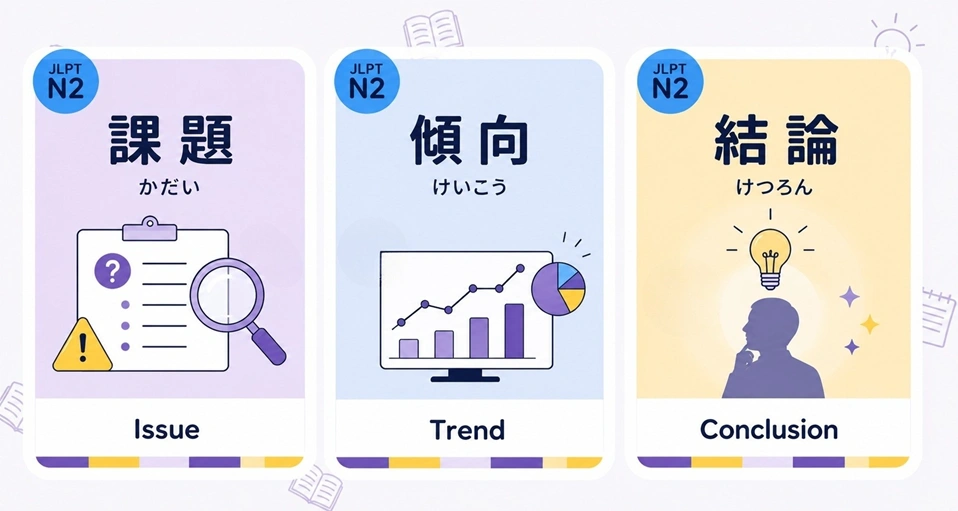
JLPT N2 at a Glance
- Level: Upper-intermediate to pre-advanced Japanese
- Kanji: About 1,000 characters
- Vocabulary: Around 6,000+ words
- Grammar: Nuance, contrast, judgment, written style, and logical connections
- Main challenge: Understanding longer passages, abstract topics, and the writer’s intention
Note: Numbers are approximate study targets. The official JLPT does not publish exact kanji or vocabulary lists.
What Makes JLPT N2 Challenging?
At this level, it becomes important to understand the flow of ideas in reading passages and conversations, as well as what the writer or speaker wants to express.
This is why N2 study should focus not only on individual language points, but also on how vocabulary, grammar, and connectors work together inside a text or conversation.
Abstract Vocabulary
At N2, vocabulary becomes more abstract, and you will see more words used to explain opinions, causes, changes, evaluations, and conclusions.
Reading the Full Passage
N2 reading often requires you to follow the topic, reason, contrast, example, and conclusion across a full passage.
Writer’s Opinion and Intention
Many N2 questions ask you to understand the writer’s main point or opinion, not only the details written in the passage.
Listening for Conclusions
In listening, the final answer may depend on a change of plan, a suggestion, hesitation, or an implied decision.
How Many Kanji Do You Need for JLPT N2?
Most JLPT N2 learners aim for around 1,000 kanji. You need to recognize kanji quickly inside longer reading passages, opinion-based texts, explanations, and practical materials.
At N2, kanji often appears in vocabulary related to social issues, opinions, trends, and workplace communication. Examples include 影響 (influence), 傾向 (tendency), 課題 (issue), and 対策 (countermeasure). The next section introduces more N2 vocabulary by category.
Common JLPT N2 Vocabulary by Category
The categories below show common N2-style vocabulary that often appears in reading texts, workplace communication, opinion-based topics, and logical explanations.
Society, Issues & Countermeasures
課題 / 現象 / 対策 / 影響
Translation: issue, phenomenon, countermeasure, influence
Opinions, Arguments & Evidence
主張 / 観点 / 根拠 / 判断
Translation: claim, viewpoint, evidence, judgment
Trends, Factors & Change
傾向 / 要因 / 推移 / 動向
Translation: tendency, factor, transition, trend
Work, Responsibility & Duties
責任 / 義務 / 対応 / 業務
Translation: responsibility, duty, response, work duties
Logic, Analysis & Conclusions
原因 / 結果 / 解決 / 結論
Translation: cause, result, solution, conclusion
Awareness, Evaluation & Perspectives
意識 / 評価 / 認識 / 観点
Translation: awareness, evaluation, recognition, viewpoint
N2 Reading Strategy
In JLPT N2 reading, it is helpful to read for the overall flow of the passage. Pay attention to how the writer introduces a topic, explains a reason, gives an example, shows contrast, and reaches a conclusion.
N2 Reading Checkpoints
- What is the main topic?
- What is the writer trying to explain?
- Where does the passage show contrast?
- Which examples support the main point?
- What is the final conclusion?
Connectors such as 一方で, つまり, したがって, そのため, and とはいえ are important because they show how ideas are connected. By noticing these signals, you can follow the main point more easily.
N2 Connectors and Writer’s Intention
In JLPT N2 reading, connectors help you understand how the writer develops an idea across a passage. They show contrast, reasons, explanations, conclusions, and changes in direction. By noticing these signals, you can follow the writer’s logic more naturally.
| Function | Useful Expressions | What to Notice |
|---|---|---|
| Contrast | 一方で / それに対して / とはいえ | The writer compares two ideas or changes direction. |
| Reason & Background | そのため / なぜなら / というのは / その背景には | The writer explains why something happens. |
| Examples & Explanation | 例えば / 具体的には / 実際に | The writer adds examples or explains an idea in more detail. |
| Conclusion | つまり / したがって / 以上のことから | The writer summarizes the main point or reaches a conclusion. |
Examples
- オンライン学習は便利です。一方で、自己管理も必要です。
Online learning is convenient. On the other hand, it also requires self-discipline. - 多くの人が便利さを求めています。そのため、オンラインサービスは急速に広がっています。
Many people want convenience. As a result, online services are expanding rapidly. - この制度には問題点もあります。とはいえ、完全に廃止するのは簡単ではありません。
This system has some problems. Even so, it is not easy to abolish it completely. - 若者の読書量は減っています。つまり、本を読む習慣そのものが変化しているのです。
In other words, the habit of reading books itself is changing.
Tip: In N2 reading, connectors often reveal the writer’s explanation, contrast, or conclusion. Paying attention to these signals can help you understand the overall flow of a passage more efficiently.
Core N2 Grammar Patterns
Many N2 grammar patterns are used to express opinions, contrast, conclusions, and relationships between ideas. These patterns often appear in reading passages, opinion-based texts, and formal written Japanese.
| Grammar Pattern | Meaning | Example |
|---|---|---|
| 〜に違いない | must be / there is no doubt that | あの店はいつも行列ができているので、おいしいに違いありません。 That restaurant always has a long line, so it must be good. |
| 〜とは限らない | not necessarily | 単語を知っているからといって、文章を理解できるとは限りません。 Knowing vocabulary does not necessarily mean you can understand a passage. |
| 〜からといって | just because / even if | 値段が高いからといって、必ずしも品質がよいとは限りません。 Just because something is expensive does not necessarily mean it is high quality. |
| 〜わけではない | it does not mean that / not always | 甘い物が嫌いなわけではありませんが、あまり食べません。 It's not that I dislike sweets, but I don't eat them very often. |
| 〜ことになっている | it is decided that / it is a rule that | 日本では、車は左側を走ることになっています。 In Japan, cars are required to drive on the left side. |
| 〜にかかわらず | regardless of / irrespective of | 経験の有無にかかわらず、だれでも応募できます。 Anyone can apply regardless of whether they have prior experience. |
These are only a few examples of N2 grammar patterns. To see how these expressions are used in more natural situations, you can also read our guide to JLPT N2 grammar examples in real Japanese, with sample sentences, short conversations, and everyday contexts.
N2 Listening Strategy
JLPT N2 listening often requires you to follow how ideas develop during a conversation and understand the speaker's intention, opinion, or final decision. Many questions also ask you to identify information that is implied rather than stated directly.
Key Listening Skills for N2
- What is the main situation or problem?
- How does the situation or plan change during the conversation?
- What does the speaker decide or need to do?
- What opinion or attitude does the speaker express?
- What information is implied rather than stated directly?
How To Study For JLPT N2 Effectively
The strategies below can help you study N2 vocabulary, grammar, reading, and listening more effectively.
Learn Vocabulary in Context
Study vocabulary through example sentences and short passages rather than isolated word lists.
Practice Reading Regularly
Practice reading N2-level passages and identifying the topic, main point, reasons, and conclusions.
Study Grammar Through Examples
Learn how grammar patterns are used in real situations so you can recognize them quickly in context.
Build Listening Skills
Use podcasts, YouTube videos, interviews, and JLPT-style listening materials to practice identifying opinions, contrasts, and final decisions.
For additional practice, you can also explore our Teachers Blog. Many articles include audio, Japanese text, and useful vocabulary, so you can practice reading, listening, and vocabulary with real Japanese content.
Best Japonin Lessons for JLPT N2 Learners
Japonin offers flexible online Japanese lessons taught by experienced professional teachers. For N2 learners, the best lesson depends on your current level, weak points, and study goals.
Intermediate Grammar
Recommended if you want to strengthen your grammar foundation and prepare for N2-level reading and listening.
View Intermediate Grammar DetailsJLPT N2 Prep Course NEW
Designed for learners who want focused preparation for the JLPT N2 exam, including grammar, vocabulary, reading, listening, and test strategies.
View JLPT N2 Course DetailsPrivate Lessons
Recommended if you need personalized support for JLPT N2 preparation, reading practice, speaking practice, or workplace Japanese.
View Private Lesson DetailsMeet Our JLPT N2 Teachers
Japonin teachers are certified Japanese-language professionals with years of experience teaching learners from beginner to advanced levels.

YOKOZUKA Noriko
- 21+ years of total teaching experience
- JLPT preparation and intermediate to advanced Japanese lessons

YAMAMOTO Hiroshi
- 10+ years of total teaching experience
- JLPT, grammar, and business Japanese lessons

WAKO harumi
- 11+ years of total teaching experience
- JLPT and practical communication lessons
Build Your JLPT N2 Skills With Japonin (JOI) Teachers
All Japonin (JOI) teachers are certified professionals with an average of 15+ years of teaching experience.
Through conversation-based lessons, you’ll strengthen practical JLPT N2 grammar, vocabulary, and reading skills while learning how Japanese is naturally used in everyday conversations and real situations.

Since 2006, Japonin (JOI) has helped over 6,000 learners worldwide study Japanese online through expert guidance from our certified and experienced teachers.

Written by Chiho Kamioka Founder JLPT Guide Editor
We created this JLPT N2 guide to make N2 study easier to understand. We hope it helps you see what to focus on and how to build your kanji, vocabulary, grammar, reading, and listening skills step by step.