


JLPT N1 Study Guide: Kanji, Vocabulary, Grammar, Reading & Listening Strategy
This guide explains what makes JLPT N1 challenging and how to study advanced vocabulary, kanji, grammar, reading, listening, and test strategy.
Updated: 2026-06-07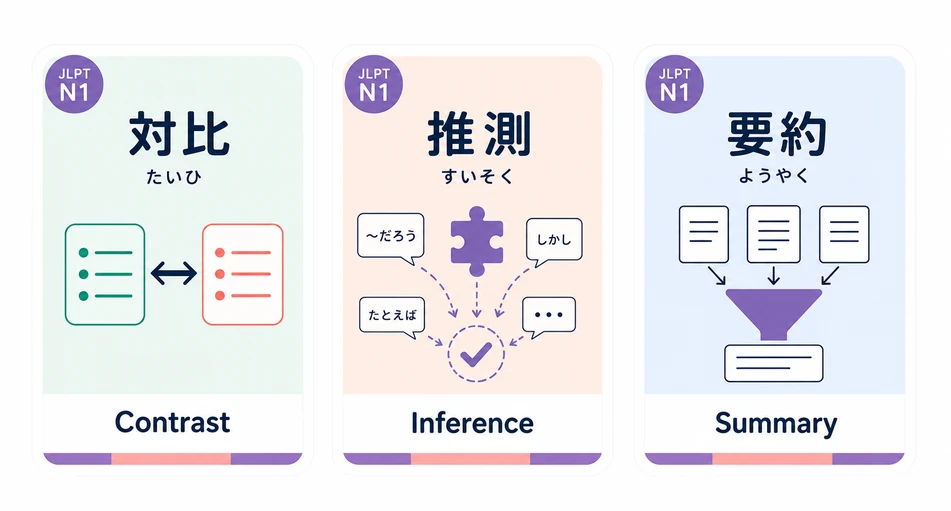
JLPT N1 at a Glance
- Level: Advanced Japanese, after completing N2
- Kanji: About 2,000 characters
- Vocabulary: Around 10,000+ words
- Grammar: Formal expressions, written style, nuance, emphasis, and complex sentence patterns
- Main challenge: Understanding complex passages, implied meanings, and the writer’s position
Note: Numbers are approximate study targets. The official JLPT does not publish exact kanji or vocabulary lists.
What Makes JLPT N1 Challenging?
JLPT N1 is the most advanced level of the Japanese Language Proficiency Test. It requires learners to handle longer, denser, and more abstract Japanese across reading and listening tasks.
Abstract and Formal Vocabulary
N1 includes many words used in opinion essays, academic texts, social commentary, business writing, and formal explanations.
Complex Reading Passages
N1 reading requires you to follow long passages, abstract arguments, examples, counterarguments, and conclusions.
Implied Meaning and Nuance
N1 questions often require you to understand what the writer or speaker really means, including subtle tone, attitude, and ideas that are not stated directly.
Speed and Accuracy
You need to read and listen efficiently while accurately understanding the main point, details, relationships, and overall logic.
How Many Kanji Do You Need for JLPT N1?
Most JLPT N1 learners aim for around 2,000 kanji. You need to recognize kanji quickly in long reading passages, essays, editorials, academic-style texts, and formal explanations.
At N1, kanji often appears in vocabulary related to society, systems, values, research, evaluation, and policy. Examples include 概念 (concept), 構造 (structure), 妥当 (appropriate / reasonable), and 検証 (verification). The next section introduces more N1 vocabulary by category.
Common JLPT N1 Vocabulary by Category
The categories below show common N1-style vocabulary that often appears in advanced reading texts, formal explanations, social topics, opinion essays, and professional communication.
Concepts, Structures & Essence
概念 / 構造 / 枠組み / 本質
Translation: concept, structure, framework, essence
Recognition, Awareness & Values
認識 / 価値観 / 見解 / 視点
Translation: recognition, values, view, perspective
Policy, Society & Change
施策 / 格差 / 変革 / 普及
Translation: policy measure, gap, reform, spread
Evaluation, Validity & Judgment
妥当 / 適切 / 評価 / 判断
Translation: valid, appropriate, evaluation, judgment
Research, Analysis & Evidence
検証 / 分析 / 根拠 / 実証
Translation: verification, analysis, evidence, demonstration
Attitude, Tendency & Implication
姿勢 / 傾向 / 顕著 / 示唆
Translation: attitude, tendency, remarkable, implication
N1 Reading Strategy
In JLPT N1 reading, it is important to understand how the writer builds an argument across the whole passage. Many passages move from an abstract topic to a problem, examples, counterarguments, and the writer’s final position.
While N2 reading often focuses on following the main idea and the writer’s intention, N1 reading requires you to understand more abstract arguments, subtle criticism, and ideas that are only implied.
N1 Reading Checkpoints
- What issue or question is the writer exploring?
- What position does the writer take?
- Which part is an example, and which part is the main argument?
- Where does the writer show contrast, doubt, or criticism?
- What idea is implied but not stated directly?
- How is the final conclusion connected to the whole passage?
At N1, answer choices are often strongly paraphrased. The correct answer may not use the same words as the passage, so you need to compare meanings carefully and choose the option that best matches the writer’s overall argument.
N1 Logical Expressions and Reading Clues
In JLPT N1 reading, connectors and other logical expressions help you follow how the writer develops an argument. These expressions can show contrast, limitation, emphasis, background, restatement, or a shift in perspective.
| Function | Useful Expressions | What to Notice |
|---|---|---|
| Contrast and Limitation | とはいえ / もっとも / その一方で / 一方では | The writer adds a limitation, exception, or different viewpoint. |
| Emphasis and Limitation | まさに / にほかならない / にすぎない / とりわけ | The writer strongly evaluates, emphasizes, or limits the meaning of something. |
| Reasoning and Background | というのも / 背景には / 要因として / 一因として | The writer explains the background or reason behind a situation or opinion. |
| Conclusion and Restatement | 以上のことから / すなわち / 要するに / 言い換えれば | The writer summarizes the argument, restates the point, or presents a conclusion. |
Examples
- この制度には一定の効果がある。とはいえ、すべての問題を解決できるわけではない。
This system has a certain effect. Even so, it cannot solve every problem. - 若者の働き方は多様になっている。その一方で、安定した収入を得にくいという問題もある。
Young people’s ways of working are becoming more diverse. On the other hand, there is also the problem that it can be difficult to earn a stable income. - 便利さだけを追求すれば、人との関わりが薄れるおそれがある。すなわち、効率と人間関係の両立が課題なのである。
If we pursue only convenience, human relationships may become weaker. In other words, the challenge is balancing efficiency and human relationships.
Tip: In N1 reading, expressions such as とはいえ, もっとも, 言い換えれば, and すなわち can help you follow contrast, restatement, and shifts in the writer’s perspective.
Core N1 Grammar Patterns
Many N1 grammar patterns are used in formal writing, news articles, essays, academic texts, business documents, and opinion-based passages. They often express judgment, necessity, limitation, or formal relationships between ideas.
| Grammar Pattern | Meaning | Example |
|---|---|---|
| 〜にこしたことはない | it is best to / there is nothing better than | 準備は早めにしておくにこしたことはありません。 It is best to prepare early. |
| 〜を余儀なくされる | to be forced to / to have no choice but to | 台風の影響で、イベントは延期を余儀なくされました。 Due to the typhoon, the event was forced to be postponed. |
| 〜に至るまで | even as far as / down to | 会議の資料から座席の配置に至るまで、細かく確認しました。 We checked everything in detail, from the meeting materials to the seating arrangement. |
| 〜までもない | there is no need to / it goes without saying | 説明するまでもなく、この問題は早急に対応すべきです。 Needless to say, this issue should be addressed immediately. |
| 〜ずにはおかない | will certainly cause / cannot help but cause | 彼の発言は、多くの人に議論を起こさずにはおかないでしょう。 His statement will surely spark discussion among many people. |
| 〜いかんで | depending on | 今後の対応は、調査結果いかんで決定されます。 The future response will be decided depending on the results of the investigation. |
For more natural examples, you can also read our JLPT N1 Grammar Examples guide, which explains useful N1 patterns such as 〜にとどまらず, 〜をふまえて, and 〜なくしては through conversations about AI, robots, and society.
N1 Listening Strategy
JLPT N1 listening requires you to understand not only the information being stated, but also the speaker’s attitude, purpose, and overall point. You need to follow how the conversation or explanation develops and understand what the speaker ultimately means.
Key Listening Skills for N1
- What issue or viewpoint is the speaker focusing on?
- What is the speaker’s attitude or purpose?
- What information is implied rather than stated directly?
- How are the details connected to the speaker’s main point?
- What is the main message of the conversation or explanation?
How To Study For JLPT N1 Effectively
The strategies below can help you study N1 vocabulary, grammar, reading, and listening more effectively.
Study Vocabulary Through Topics
Group words by themes such as society, values, systems, work, research, and evaluation. This helps you understand N1 reading passages more naturally.
Follow the Writer’s Logic
Practice identifying the main issue, examples, contrast, different viewpoints, and conclusion in each passage.
Compare Similar Grammar
Many N1 grammar patterns have similar meanings but different tone, formality, and usage. Study them through examples.
Use Real Japanese Materials
Read editorials, essays, interviews, business articles, and advanced Japanese materials to build speed and confidence.
For additional practice, you can also explore our Teachers Blog. Many articles include audio, Japanese text, and useful vocabulary, so you can practice understanding longer explanations, opinions, and real Japanese expressions.
Best Japonin Lessons for JLPT N1 Learners
Japonin offers flexible online Japanese lessons taught by experienced professional teachers. For N1 learners, the best lesson depends on your current level, weak points, and study goals.
Advanced Grammar
Recommended if you want to strengthen N1-level grammar, formal expressions, and advanced reading comprehension.
View Advanced Grammar DetailsJLPT N1 Prep Course NEW
Designed for learners who want focused preparation for the JLPT N1 exam, including vocabulary, grammar, reading, listening, and test strategies.
View JLPT N1 Course DetailsPrivate Lessons
Recommended if you need personalized support for N1 reading, grammar, speaking practice, writing support, or professional Japanese.
View Private Lesson DetailsMeet Our JLPT N1 Teachers
Japonin teachers are certified Japanese-language professionals with years of experience teaching learners from beginner to advanced levels.

YOKOZUKA Noriko
- 21+ years of total teaching experience
- JLPT preparation and intermediate to advanced Japanese lessons

HAYASHI Ayumi
- 13+ years of total teaching experience
- JLPT preparation and grammar-focused Japanese lessons

WAKO Harumi
- 11+ years of total teaching experience
- JLPT and practical communication lessons
Build Your JLPT N1 Skills With Japonin (JOI) Teachers
All Japonin (JOI) teachers are certified professionals with an average of 15+ years of teaching experience.
Through conversation-based lessons, you’ll strengthen practical JLPT N1 grammar, vocabulary, reading, and listening skills while learning how advanced Japanese is used in real contexts.

Since 2006, Japonin (JOI) has helped over 6,000 learners worldwide study Japanese online through expert guidance from our certified and experienced teachers.

Written by Chiho Kamioka Founder JLPT Guide Editor
We created this JLPT N1 guide to help advanced learners organize their study and understand what to focus on. It covers the kanji, vocabulary, grammar, reading, and listening skills needed to handle more complex Japanese with confidence.