

JLPT and CEFR Comparison Chart
Score-Based CEFR Levels and Their Limitations as Indicators of Speaking Ability
Starting with the Japanese-Language Proficiency Test (JLPT) administered in December 2025, CEFR levels have been included as reference information on the score reports of successful examinees.
Based on the official comparison chart, this page explains how JLPT scores correspond to CEFR levels and what to keep in mind when interpreting this reference information.
What Is the CEFR, and How Does It Relate to the JLPT?
The Common European Framework of Reference for Languages (CEFR) is a framework developed by the Council of Europe to provide a shared basis for language learning, teaching, and assessment.
The CEFR is not a test or qualification for any specific language. Instead, it provides a common scale for describing what learners can do in a language, making it easier to understand proficiency across different languages and assessment systems.
The CEFR has six levels, from A1 to C2. A1 and A2 describe basic users, B1 and B2 describe independent users, and C1 and C2 describe proficient users.
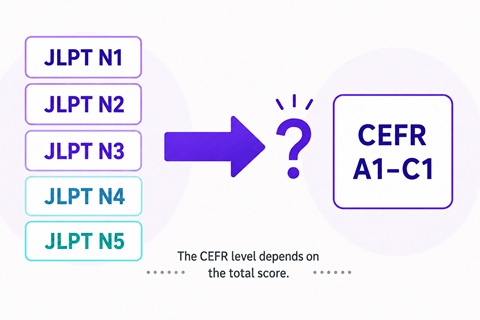
Starting with the December 2025 JLPT, score reports for successful examinees include a CEFR level for reference, based on their total score. This does not change the content of the JLPT or its pass/fail criteria; it simply provides additional information to help interpret the results.
Why Did the JLPT Add CEFR Levels to Score Reports?
As Japanese-language education and assessment have become more diverse, there has been a growing need for common indicators that make it easier to compare the levels of Japanese proficiency measured by different tests.
“...apply the JLPT test results to the international framework (CEFR) and use the CEFR level as a reference...”
Source: Official JLPT Website: “Indication of the CEFR Level for Reference”
By adding the CEFR level as reference information, JLPT results can be understood more easily using an internationally shared scale. This information can also help when comparing JLPT results with those of other Japanese-language tests that use or have been linked to the CEFR.
JLPT and CEFR Comparison Chart
For examinees who pass, a CEFR level is shown for reference based on their total JLPT score.
The total score is calculated by adding together the scores for each test section. The sections included vary depending on the JLPT level taken.
- N1, N2, and N3: The combined scores for “Language Knowledge (Vocabulary/Grammar),” “Reading,” and “Listening”
- N4 and N5: The combined scores for “Language Knowledge (Vocabulary/Grammar) and Reading” and “Listening”
The maximum total score is 180 for every level. However, meeting the overall passing score is not enough on its own. If the score in any test section falls below the required minimum, the examinee does not pass, and no CEFR level is shown.
The official correspondence between JLPT total scores and CEFR levels, from N5 to N1, is shown below.
| JLPT Level | Total Score | CEFR Level (For Reference) |
|---|---|---|
| N5 | 80–180 | A1 |
| N4 | 90–180 | A2 |
| N3 | 95–103 | A2 |
| 104–180 | B1 | |
| N2 | 90–111 | B1 |
| 112–180 | B2 | |
| N1 | 100–141 | B2 |
| 142–180 | C1 |
*The JLPT indicates CEFR levels only up to C1. C2 is not included.
Source: Official JLPT Website: “Indication of the CEFR Level for Reference”
JLPT and CEFR levels do not correspond on a one-to-one basis.
For successful N5 examinees, the reference level is A1; for successful N4 examinees, it is A2. For N3, N2, and N1, however, the CEFR level shown depends on the examinee’s total score. This means that people who pass the same JLPT level may receive different CEFR levels.
For example, among examinees who pass N2, a total score of 90–111 corresponds to B1, while a score of 112 or higher corresponds to B2. The CEFR reference information therefore provides a more detailed picture of an examinee’s performance than the JLPT pass level alone.
The JLPT Does Not Directly Assess Speaking Ability
“It does not include skills such as ‘Production (speaking and writing)’ and ‘Interaction’ that are not tested by the JLPT.”
Source: Official JLPT Website: “Indication of the CEFR Level for Reference”
The CEFR level shown for reference reflects only the skills assessed by the JLPT: language knowledge, reading, and listening. It does not represent overall Japanese proficiency, which also includes speaking, writing, and interaction.
Even learners who have passed the JLPT may struggle to express themselves smoothly in conversation. JLPT results and practical communication skills should therefore be considered separately.
Because the JLPT does not directly assess speaking or interaction, test results alone may not fully reflect how well someone can communicate in the workplace. For example:
- Customer service: An employee may understand a customer’s basic request but have difficulty asking follow-up questions or confirming details when an unexpected situation arises. In such cases, support from another staff member may be needed.
- Workplace communication: An employee may understand written documents and manuals but have difficulty explaining a problem verbally or asking for clarification when instructions are unclear. This can lead to delays or misunderstandings.
For this reason, JLPT results should be considered together with the practical communication skills required for the role, such as understanding customer requests, confirming instructions, and reporting a situation to a supervisor.
At Japonin, We Focus on What Learners Can Do in Japanese
In our conversation classes, we set learning objectives with reference to the CEFR, focusing on what learners can do in Japanese.
Learners do more than study grammar and vocabulary. They gradually develop the skills needed to use Japanese in real-life situations, such as introducing themselves, asking questions, explaining their ideas, and exchanging opinions.
*At Japonin, CEFR levels are used as guidelines for setting learning goals and tracking progress. They do not represent formal test results or certifications.
Build the Japanese Skills You Need
Japonin offers online lessons for a variety of goals, including improving conversation skills, preparing for the JLPT, and learning the Japanese needed in the workplace.
Improve Your Conversation Skills
Our conversation lessons, from beginner to advanced levels, help learners build the confidence and practical skills to communicate in Japanese.
Prepare for the JLPT
Develop the grammar, vocabulary, reading, and listening skills needed to pass the JLPT.
For Companies and Organizations
We provide training tailored to your goals, including Japanese for customer service, workplace communication, reporting, and JLPT preparation.
Frequently Asked Questions About JLPT and CEFR Levels
Is JLPT N3 equivalent to CEFR B1?
Not always. For examinees who pass N3, the CEFR level shown for reference is A2 for a total score of 95–103 and B1 for a score of 104 or higher.
Is JLPT N2 equivalent to CEFR B1 or B2?
It can correspond to either level. For examinees who pass N2, the CEFR level shown for reference is B1 for a total score of 90–111 and B2 for a score of 112 or higher.
Does passing JLPT N1 mean that your CEFR level is C1?
Not necessarily. For examinees who pass N1, the CEFR level shown for reference is B2 for a total score of 100–141 and C1 for a score of 142 or higher.
Does the JLPT show a CEFR C2 level?
No. The CEFR levels shown for reference on JLPT score reports range from A1 to C1. C2 is not included.
Is a CEFR level shown if you do not pass the JLPT?
No. A CEFR level is shown only for examinees who pass. Even if the total score meets the overall passing score, an examinee does not pass if the score in any test section is below the required minimum.
Does the CEFR level shown on a JLPT score report indicate speaking ability?
No. The JLPT does not directly assess speaking, writing, or interaction. The CEFR level shown for reference therefore does not directly indicate a learner’s speaking ability.
Summary
The CEFR level shown for reference makes it easier to interpret JLPT results using the internationally recognized CEFR scale. On JLPT score reports, the reference levels range from A1 to C1. For N3, N2, and N1, the level shown depends on the examinee’s total score, so people who pass the same JLPT level may receive different CEFR levels.
This reference information covers only the language knowledge, reading, and listening skills assessed by the JLPT. It does not directly reflect a learner’s speaking, writing, or interaction skills.
When assessing the Japanese proficiency of a learner or employee, it is therefore important to consider not only their JLPT results but also what they can actually do in Japanese.
References
- Official JLPT Website: “CEFR Level to Be Added for Reference to JLPT Score Reports from the December 2025 JLPT”
- Official JLPT Website: “Indication of the CEFR Level for Reference”
*This page is based on official information available as of July 2026. Please refer to the official JLPT website for the latest information.
Since 2006, Japonin has supported more than 6,000 learners worldwide through lessons taught by experienced Japanese-language teachers.

Chiho Kamioka Founder of Japonin
Based on information from the official JLPT website, this article explains how JLPT total scores correspond to CEFR levels and why these results do not necessarily reflect a learner’s speaking ability.
Helpful JLPT Resources
Explore Japonin's JLPT study guides and grammar resources from N5 to N1.