

30 Japanese Shortened Words You’ll Hear in Everyday Conversation
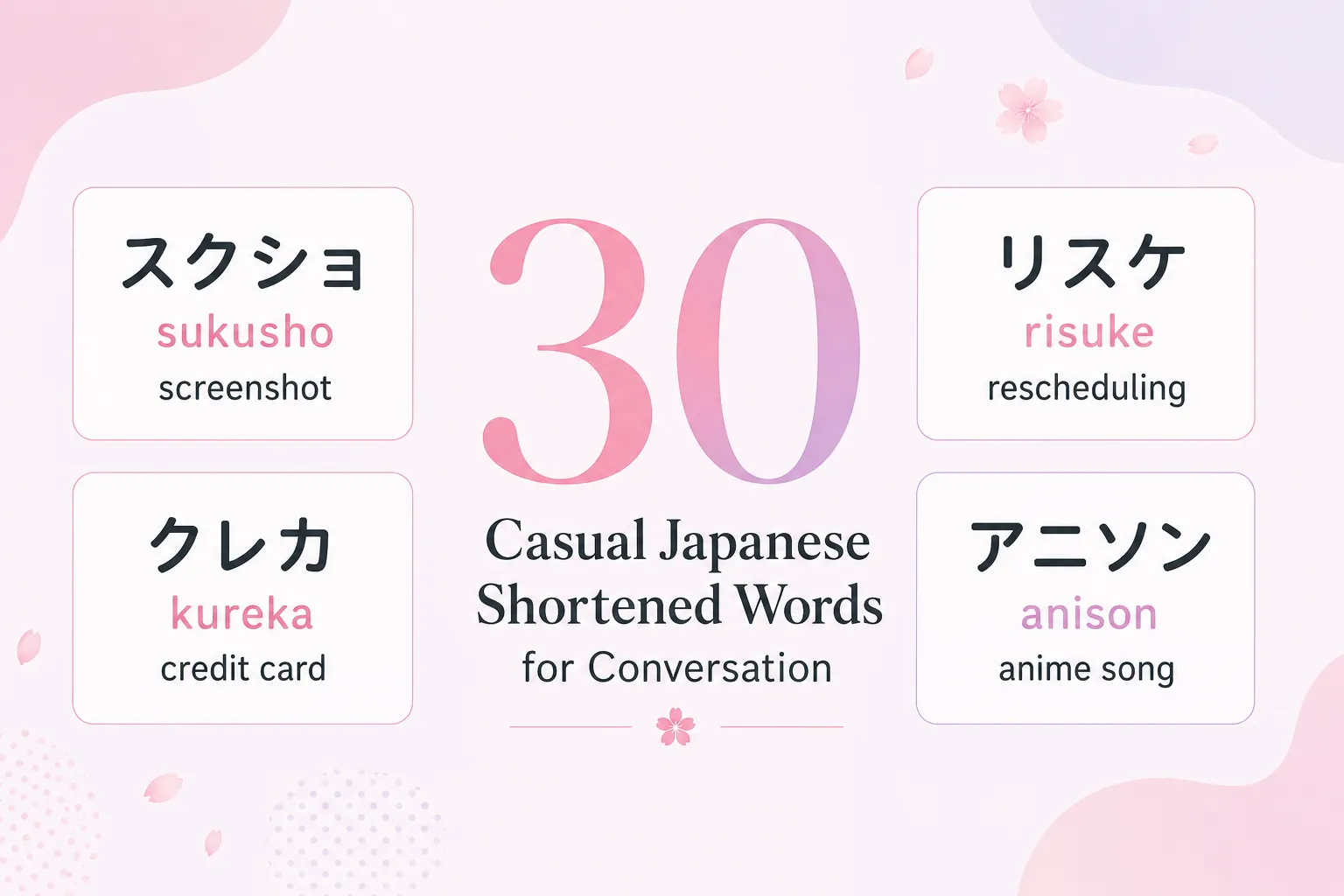
Japanese conversation includes many shortened words such as スクショ (sukusho), コピペ (kopipe), リスケ (risuke), and モチベ (mochibe). Learn 30 common conversational shortenings, with natural examples and simple notes on when to use them.
Written by Chiho Kamioka ·
How Casual Are These Japanese Shortened Words?
Not every shortened Japanese word is equally casual. Words such as コンビニ, パソコン, and スマホ are now normal everyday vocabulary, while others are mainly used in casual conversation, chats, or specific social contexts.
Because the appropriate situation varies from word to word, we’ve included a Usage note for each one to show how it sounds to native speakers and where it sounds natural. Check these notes as you go: some are fine with coworkers but too casual for clients or formal writing, while others are better to recognize than to use yourself.
Online & Tech
These shortened forms are especially common in messages, apps, videos, and everyday digital conversation.
| Shortened Word | Longer Form / Origin | Meaning | Natural Example |
|---|---|---|---|
| メアド
meado
|
メールアドレス | email address | あとでメアド送るね。
ato de meado okuru ne.
I’ll send you my email address later.
Usage:.Casual and common in relaxed conversation and messages. Avoid it with customers, people you do not know well, or in formal writing. メールアドレス is more neutral.
|
| コピペ
kopipe
|
コピー&ペースト | copy and paste | ここ、コピペしていい?
koko, kopipe shite ii?
Can I copy and paste this part?
Usage: Common in casual conversation and chats. It is also used among coworkers in relaxed internal communication, but avoid it in formal business writing.
|
| スクショ
sukusho
|
スクリーンショット | screenshot | その画面のスクショを送って。
sono gamen no sukusho o okutte.
Send me a screenshot of that screen.
Usage: Very common in casual conversation and chats, but avoid it in formal business communication. Use スクリーンショット in more formal situations.
|
| サムネ
samune
|
サムネイル | thumbnail | サムネ変えたんだ。
samune kaetan da.
I changed the thumbnail.
Usage: Common and natural when talking about videos, websites, and social media. It is casual but widely understood; サムネイル is more neutral in formal contexts.
|
| ドラレコ
dorareko
|
ドライブレコーダー | dashcam | ドラレコついてる?
dorareko tsuiteru?
Does your car have a dashcam?
Usage: Widely understood, especially when talking about cars. Use ドライブレコーダー in formal or official contexts.
|
| ネカフェ
nekafe
|
ネットカフェ | internet café | ネカフェでちょっと休んだ。
nekafe de chotto yasunda.
I took a short break at an internet café.
Usage: .Quite casual and conversational. Common among friends and in relaxed conversation, but avoid it in formal or customer-facing situations. ネットカフェ is more neutral.
|
Shops & Places
You will hear these shorter forms when shopping, eating out, traveling, or talking casually about places in town.
| Shortened Word | Longer Form / Origin | Meaning | Natural Example |
|---|---|---|---|
| 100均
hyakkin
|
100円均一(ショップ) | 100-yen shop | これ、100均で買った。
kore, hyakkin de katta.
I bought this at a 100-yen shop.
Usage: Very common in conversation and widely understood across age groups. 100円ショップ is more neutral.
|
| ファミレス
famiresu
|
ファミリーレストラン | family restaurant | 今日はファミレスでいい?
kyou wa famiresu de ii?
How about a family restaurant today?
Usage: Very common in everyday conversation. It sounds casual, while ファミリーレストラン is more neutral.
|
| フリマ
furima
|
フリーマーケット | flea market / resale marketplace | 古い服をフリマで売りました。
furui fuku o furima de urimashita.
I sold some old clothes on a flea-market app / marketplace.
Usage: Common and widely understood in casual conversation, especially when talking about flea markets or resale apps. In more formal contexts, use a specific term such as フリーマーケット or フリマアプリ.
|
| デパ地下
depachika
|
デパートの地下売り場 | department store basement food hall | 今日は、デパ地下でお弁当を買います。
kyou wa, depachika de obentou o kaimasu.
I’m going to buy a bento at the department store food hall today.
Usage: Widely understood and often heard in conversation and the media. It is informal but not especially youth-oriented.
|
| ビジホ
bijiho
|
ビジネスホテル | business hotel | 駅前のビジホに泊まった。
ekimae no bijiho ni tomatta.
I stayed at a business hotel near the station.
Usage: Quite casual and often seen online or used in relaxed conversation. Use ビジネスホテル for reservations, customer communication, or formal writing.
|
| ゲーセン
geesen
|
ゲームセンター | arcade | 帰りにゲーセン寄ろう。
kaeri ni geesen yorou.
Let’s stop by the arcade on the way home.
Usage: Very casual and conversational. Common among friends and in relaxed conversation, but ゲームセンター is more appropriate in neutral, official, or formal contexts.
|
Work & School
Some shortened forms are common among classmates and coworkers. They are useful to understand in everyday school and workplace conversation.
| Shortened Word | Longer Form / Origin | Meaning | Natural Example |
|---|---|---|---|
| バイト
baito
|
アルバイト | part-time job | 今日の夜はバイトに行くよ。
kyou no yoru wa, baito ni iku yo.
I have a shift at my part-time job tonight.
Usage: Very common in everyday conversation. Use アルバイト on job applications, official forms, or in formal situations.
|
| パワポ
pawapo
|
PowerPoint | PowerPoint / slide deck | あとで、パワポを送りますね。
ato de, pawapo o okurimasu ne.
I’ll send you the PowerPoint later.
Usage: Common in casual school and internal workplace conversation, but avoid it in formal business communication. Use パワーポイント instead.
|
| アポ
apo
|
アポイントメント | appointment | 明日のアポ、何時だっけ?
ashita no apo, nanji dakke?
What time is tomorrow’s appointment again?
Usage: Quite casual and mainly used among coworkers in relaxed workplace conversation. Avoid it with supervisors, clients, or in formal business communication. Use アポイントメント or a more formal expression instead.
|
| リスケ
risuke
|
リスケジュール | rescheduling | 来週にリスケできる?
raishuu ni risuke dekiru?
Can we reschedule it for next week?
Usage: Quite casual and commonly used among coworkers in relaxed conversation or messages. Avoid it with supervisors, clients, or in formal business communication. Use expressions such as 日程を変更する instead.
|
| 学祭
gakusai
|
学園祭 | school / university festival | 来週、大学の学祭があります。
raishuu, daigaku no gakusai ga arimasu.
There’s a university festival next week.
Usage: Common among students and in casual conversation. Use 学園祭 in official announcements, formal writing, or more neutral situations.
|
| 卒論
sotsuron
|
卒業論文 | graduation thesis | 卒論がまだ終わってない。
sotsuron ga mada owattenai.
I still haven’t finished my graduation thesis.
Usage: Very common among university students. Use 卒業論文 in academic or official writing.
|
Daily Life & Lifestyle
These shortened forms come up in casual conversations about everyday life, shopping, health, and personal interests
| Shortened Word | Longer Form / Origin | Meaning | Natural Example |
|---|---|---|---|
| クレカ
kureka
|
クレジットカード | credit card | クレカ使えますか?
kureka tsukaemasu ka?
Can I pay by credit card?
Usage: Very common and widely understood in everyday conversation and online. It can also be used naturally in shops and other casual service situations. Use クレジットカード in formal business writing or official communication.
|
| ドタキャン
dotakyan
|
土壇場 + キャンセル | last-minute cancellation | またドタキャンされた。
mata dotakyan sareta.
They canceled on me at the last minute again.
Usage: Very casual and commonly used in relaxed conversation. It can also sound blunt or critical, so avoid it with clients or in formal or customer-facing communication.
|
| インフル
infuru
|
インフルエンザ | influenza / the flu | インフルで、会社を3日間休みました。
infuru de, kaisha o mikka-kan yasumimashita.
I took three days off work because I had the flu.
Usage: Very common in everyday conversation and widely understood across age groups. Use インフルエンザ in medical, official, or formal contexts.
|
| モチベ
mochibe
|
モチベーション | motivation | 最近モチベ上がらない。
saikin mochibe agaranai.
I haven’t felt very motivated lately.
Usage: Casual and common in relaxed conversation. It may be used among close coworkers, but avoid it with supervisors, clients, or in formal business communication. Use モチベーション instead.
|
| プチプラ
puchipura
|
プチプライス | affordable / budget-friendly | このシャンプー、プチプラだけどすごくいいです。
kono shanpuu, puchipura da kedo sugoku ii desu.
This shampoo is affordable, but it’s really good.
Usage: Common in casual conversation, especially when talking about beauty, fashion, and everyday products. It sounds casual, so use more neutral wording in formal situations.
|
| ポイ活
poikatsu
|
ポイントを貯める活動 | collecting reward points | 最近ポイ活してる。
saikin poikatsu shiteru.
I’ve been collecting reward points lately.
Usage: Casual and trend-based. Common in lifestyle media, social media, and relaxed conversation. In formal contexts, it is often better to explain the idea more explicitly. Learners may mainly need to recognize this word rather than use it themselves.
|
Who Can You Use These Shortened Words With?
Some shortened words are natural almost anywhere, while others depend on your relationship with the person you are speaking to.
These ratings are a general guide, not strict rules. What sounds natural can vary depending on your relationship with the other person, the situation, and the topic of conversation. Use the chart as a practical reference rather than an absolute rule.
If you see △ and are not sure, using the longer or more neutral form is usually the safest choice. × does not mean the word is never used in that situation, but learners are generally better off avoiding it.
| Word | Friends | Coworkers | Supervisors | Formal Business / Writing |
|---|---|---|---|---|
| Online & Tech | ||||
| メアド | ○ | △ | × | × |
| コピペ | ○ | △ | × | × |
| スクショ | ○ | △ | × | × |
| サムネ | ○ | △ | △ | × |
| ドラレコ | ○ | △ | △ | × |
| ネカフェ | ○ | △ | × | × |
| Shops & Places | ||||
| 100均 | ○ | △ | △ | × |
| ファミレス | ○ | ○ | △ | × |
| フリマ | ○ | △ | △ | × |
| デパ地下 | ○ | △ | △ | × |
| ビジホ | ○ | △ | × | × |
| ゲーセン | ○ | △ | × | × |
| Work & School | ||||
| バイト | ○ | ○ | △ | × |
| パワポ | ○ | △ | × | × |
| アポ | ○ | △ | × | × |
| リスケ | ○ | △ | × | × |
| 学祭 | ○ | △ | △ | × |
| 卒論 | ○ | ○ | △ | × |
| Daily Life & Lifestyle | ||||
| クレカ | ○ | △ | △ | × |
| ドタキャン | ○ | △ | × | × |
| インフル | ○ | ○ | △ | × |
| モチベ | ○ | △ | × | × |
| プチプラ | ○ | △ | × | × |
| ポイ活 | ○ | △ | × | × |
| Beauty, Hobbies & Entertainment | ||||
| フェス | ○ | △ | △ | × |
| ファンデ | ○ | △ | △ | × |
| 推し活 | ○ | △ | △ | × |
| アニソン | ○ | △ | △ | × |
| カラコン | ○ | △ | △ | × |
| マツエク | ○ | △ | △ | × |
Part 1
50 Everyday Japanese Abbreviations That Sound Natural
For shortened words such as コンビニ, パソコン, スマホ, and 就活 that have become normal everyday Japanese, see the companion guide.
See 50 Everyday Japanese Abbreviations →Casual Japanese Shortened Words FAQ
Since 2006, Japonin has helped over 6,000 learners worldwide study Japanese online with support from our experienced Japanese language teachers.

Written by Chiho Kamioka Founder of Japonin
Japanese learners often learn the full form first, but may not recognize the shortened form when they hear it in real conversation. I created this guide to introduce shortened words that learners are likely to hear in Japan, along with natural examples and notes on when the full form may be more appropriate.
Ready to speak more natural Japanese?
Study Japanese with experienced teachers at Japonin.
Try two 50-minute live lessons and take the next step in your Japanese learning.
More Natural Japanese Guides
Explore more guides to help you understand the shortened forms and conversation patterns you are likely to hear in real Japanese.