JLPT N5 Kanji & Vocabulary Guide
Essential facts, sample lists, and a simple study plan for beginners
JLPT N5 focuses on very basic kanji and everyday vocabulary. If you are wondering things like "how many kanji in N5" or "how many words in JLPT N5", this page gives you quick answers. You can also see sample JLPT N5 kanji list and JLPT N5 vocabulary list examples, and get simple tips on how to study efficiently without feeling overwhelmed.
Written by Chiho KamiokaUpdated: 2025-12-03
JLPT N5 at a Glance
- Level: Beginner level of the JLPT
- Kanji: About 100 basic characters
- Vocabulary: Around 800–900 essential words
- Skills: Basic reading & listening for daily-life topics
- Goal: Understand simple expressions & short texts
How Many Kanji Do You Need for JLPT N5?
JLPT N5 typically requires knowledge of about 100 basic kanji. You do not need to practice writing kanji by hand for the JLPT. Instead, focus on recognizing basic kanji in familiar words and short texts.
These kanji appear in everyday vocabulary such as 日本 (Japan), 学校 (school), 先生 (teacher), and 時間 (time).
JLPT N5 Kanji by Category
The kanji below are grouped by category to give you a clear, quick picture of the kinds of characters you will see in JLPT N5.
Numbers
一 二 三 四 五 六 七 八 九 十
Translation: 一 (one), 二 (two), 三 (three), 四 (four), 五 (five), 六 (six), 七 (seven), 八 (eight), 九 (nine), 十 (ten)
Days & Time
月 火 水 木 金 土 日
Weekday meanings: Monday, Tuesday, Wednesday, Thursday, Friday, Saturday, Sunday
年 時 分
Time-related: year, hour, minute
People & School
人 名 母 父 先 生
学 校
人 (person), 名 (name), 母 (mother), 父 (father), 先 (before), 生 (life/student), 学 (study), 校 (school)
Nature & Things
山 川 木 田 雨 雪
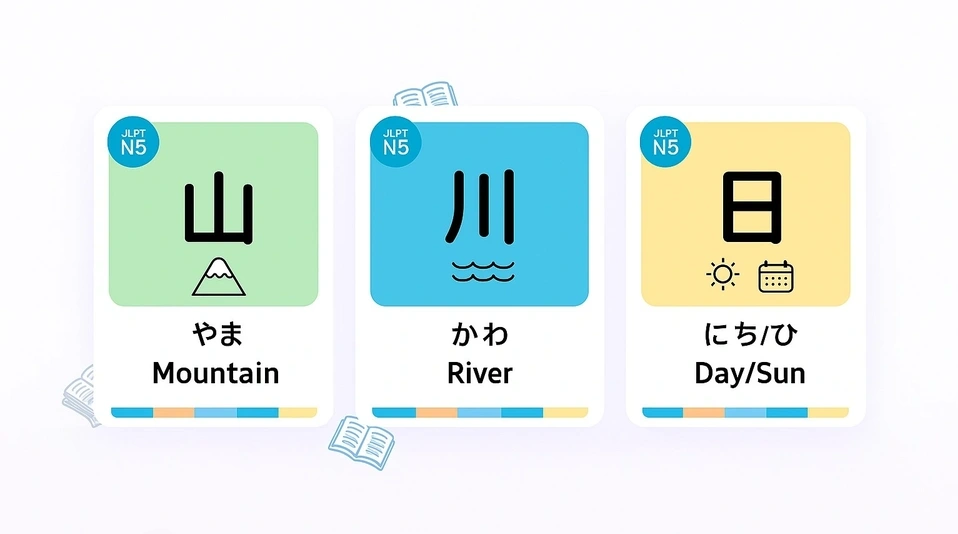
山 (mountain), 川 (river), 木 (tree), 田 (rice field), 雨 (rain), 雪 (snow)
Position & Direction
上 下 中 右 左 前 後
上 (up), 下 (down), 中 (middle), 右 (right), 左 (left), 前 (front), 後 (back)
Size & Basic Ideas
大 小 入 出 本
大 (big), 小 (small), 入 (enter), 出 (exit), 本 (book/origin)
These are only sample groups, not a complete JLPT N5 kanji list. Different textbooks and teachers may include slightly different kanji at the N5 level, but the categories above give you a reliable image of what to expect.
Sample JLPT N5 Kanji (20)
Below is a sample of 20 kanji out of about 100 N5 kanji. These give you a clear image of the type of characters you will see in a typical JLPT N5 kanji list.
| Kanji | Romaji | Hiragana | Meaning | Example Word |
|---|---|---|---|---|
| 日 | nichi / hi | にち・ひ | day / sun | 日ようび |
| 月 | getsu / tsuki | げつ・つき | month / moon | 月ようび |
| 火 | ka | か | fire | 火ようび |
| 水 | sui | すい | water | 水ようび |
| 木 | moku | もく | tree | 木ようび |
| 金 | kin | きん | gold | 金ようび |
| 土 | do | ど | earth | 土ようび |
| 人 | jin / hito | じん・ひと | person | 日 本 人 |
| 名 | na | な | name | 名 前 |
| 学 | gaku | がく | study | 学 生 |
| 校 | kō | こう | school | 学 校 |
| 先 | sen | せん | ahead | 先 生 |
| 生 | sei | せい | life / student | 生きる |
| 山 | yama | やま | mountain | 山 |
| 川 | kawa | かわ | river | 川 |
| 大 | dai / ō | だい・おお | big | 大きい |
| 小 | shō / chii | しょう・ちい | small | 小さい |
| 中 | chū / naka | ちゅう・なか | middle | 中 国 |
| 上 | jō / ue | じょう・うえ | up | 上 手 |
| 下 | ka / shita | か・した | down | 下がる |
Common N5 Kanji Mistakes
Many beginners confuse similar-looking kanji or feel unsure about stroke order. Here are some common JLPT N5 kanji mistakes and simple tips to avoid them.
Mixing up 木 and 本
木 → 本
木 (tree) has one vertical line, but 本 (book / origin) adds a short line at the bottom. Think of it as “a mark at the root of the tree”.
Confusing 人 and 入
人 vs 入
In 人 (person), the strokes are more open at the bottom. In 入る (to enter), the left stroke goes down more vertically. Imagine a “person” walking with open legs vs. an “arrow” going into a place.
Stroke Order for 日
日
Many learners draw 日 (day / sun) like a box, but kanji have correct stroke order. Learning the proper order for 日 helps later kanji (like 時) feel much easier.
大 vs 犬
大 vs 犬
大きい (big) has three simple strokes. 犬 (dog) looks similar, but has a short extra stroke on the right. If you see that “tail-like” stroke, think of a dog.
When you notice these small differences early, it becomes much easier to read a full JLPT N5 kanji list without mixing characters up.
JLPT N5 Vocabulary: How Many Words?
At the N5 level, you will work with about 800–900 vocabulary words. It may sound like a lot, but in reality this is a compact “starter toolkit” that appears again and again in beginner textbooks, apps, and lessons.
With these words you can, for example:
- Introduce yourself and talk about your country, job, and family
- Ask and answer simple questions about time, days, and weekly schedule
- Handle everyday tasks like shopping, eating out, or taking transport
- Describe things with easy adjectives such as “big/small,” “new/old,” or “fun/boring”
There is no official vocabulary list for JLPT N5. In practice, aiming for about 800–900 words is a realistic goal. Rather than trying to collect every possible word, focusing on high-frequency beginner vocabulary will help you progress much faster than trying to memorize long lists. If you can understand and use that core set comfortably, you will have enough vocabulary for the N5 level.
Sample JLPT N5 Vocabulary (20 Words + Sentences)
These 20 words are just a sample from the 800–900 words you’ll encounter when studying for N5. Beginner materials usually cover everyday nouns, verbs, adjectives, and simple expressions like the ones below.
Nouns
| Word | Romaji | Hiragana | Type | Meaning | Example Sentence |
|---|---|---|---|---|---|
| 学校 | gakkō | がっこう | N | school | 学校へ 行きます。 |
| 先生 | sensei | せんせい | N | teacher | 先生は やさしいです。 |
| 友だち | tomodachi | ともだち | N | friend | 友だちと あそびます。 |
| 学生 | gakusei | がくせい | N | student | 私は 学生です。 |
Verbs
| Word | Romaji | Hiragana | Type | Meaning | Example Sentence |
|---|---|---|---|---|---|
| 行く | iku | いく | V | to go | スーパーへ 行きます。 |
| 来る | kuru | くる | V | to come | 来て ください。 |
| 食べる | taberu | たべる | V | to eat | りんごを 食べます。 |
| 飲む | nomu | のむ | V | to drink | 水を 飲みます。 |
| 見る | miru | みる | V | to see / watch | テレビを 見ます。 |
| 聞く | kiku | きく | V | to listen | 聞いて ください。 |
| 話す | hanasu | はなす | V | to speak | 日本語で 話します。 |
| 読む | yomu | よむ | V | to read | 本を 読みます。 |
| 書く | kaku | かく | V | to write | 手紙を 書きます。 |
| 買う | kau | かう | V | to buy | パンを 買います。 |
Adjectives
| Word | Romaji | Hiragana | Type | Meaning | Example Sentence |
|---|---|---|---|---|---|
| 大きい | ōkii | おおきい | Adj-i | big | 大きい 家です。 |
| 小さい | chiisai | ちいさい | Adj-i | small | 小さい 犬が います。 |
| 新しい | atarashii | あたらしい | Adj-i | new | 新しい かばん です。 |
| 古い | furui | ふるい | Adj-i | old | 古い 本です。 |
| 楽しい | tanoshii | たのしい | Adj-i | fun | 日本語の べんきょうは 楽しいです。 |
| 近い | chikai | ちかい | Adj-i | near / close | 駅は ちかいです。 |
Mini Quiz: Can You Read These N5 Kanji & Words?
Try these short questions to check your understanding of JLPT N5 kanji and basic beginner vocabulary.
Q1. What is the correct reading of this kanji?
山
- やま
- かわ
- うみ
Show Answer
Answer: ① やま
「山」 means “mountain.”
Q2. Choose the correct kanji for this N5 sentence:
「__を 読みます。」
__ o yomimasu.
- 本
- 雨
- 口
Show Answer
Answer: ① 本
「本を読みます。」 = I read a book.
Q3. What does this N5 word mean?
「友だち」
tomodachi
- teacher
- friend
- family
Show Answer
Answer: ② friend
友だち means “friend.”
Q4. Which sentence correctly uses the adjective「ちかい」(near)?
- 本は ちかいです。
- 駅は ちかいです。
- 水を ちかいです。
Show Answer
Answer: ② 駅は ちかいです。
“The station is near.”
A Simple Study Plan for JLPT N5 (3–6 Months)
Many beginners wonder how long it takes to reach JLPT N5 or where they should even start. The good news is that N5 is very manageable if you follow a clear and simple plan. Below is an easy roadmap that many learners use successfully.
- Step 1: Start with romaji for pronunciation support, then gradually learn hiragana and katakana
- Step 2: Build core grammar (です/ます, verbs, particles)
- Step 3: Learn 800–900 beginner words and about 100 basic kanji
- Step 4: Practice N5-style reading and listening questions
If you prefer more guidance or want feedback from a teacher, many learners find it easier to progress with regular lessons. In the next section, you can see which Japonin(JOI) lessons work best for reaching JLPT N5.
Best Japonin (JOI) Lessons to Reach JLPT N5
Japonin(JOI) does not offer a JLPT N5-only course, but many beginners successfully reach N5 by combining:
- Flex Beginner 1 – CEFR-based beginner lessons that build practical conversation skills using JLPT N5–level grammar and vocabulary.
- Private lessons – one-to-one support for JLPT-style questions and weak points

Flex Beginner 1 (Group Lessons)
Perfect if you want a steady study rhythm and friendly classmates at the same level. The lessons focus on simple conversation using beginner grammar and vocabulary, and follow a CEFR-based progression that is easy to continue.
- Practice everyday conversation using N5-level patterns
- Beginner-friendly pace with clear explanations
- Flexible schedule – join classes that fit your time zone
Private Lessons (One-to-One)
Ideal if you want to focus on JLPT N5 at your own pace.
- Set a fixed weekly time with your preferred teacher for steady progress
- Follow a custom lesson plan based on your level and target test date
- Practice real JLPT-style questions and review difficult points carefully
For most learners aiming for JLPT N5, Flex Beginner 1 is the best place to start.
You can try two free lessons, meet different teachers, and learn with classmates at the same level.
After building the basics, add Private lessons only if you want extra practice.
JLPT N5 FAQ
How many kanji are required for JLPT N5?
How many vocabulary words are in JLPT N5?
Is there an official list of N5 kanji or vocabulary?
How long does it take to learn the N5 kanji and vocabulary?
Do I need to memorize all N5 kanji?
What kinds of words are included at the N5 level?
- Everyday nouns (family, school, food, places)
- Simple verbs (go, eat, see, come, do)
- Basic adjectives and adverbs
- Very common expressions and classroom phrases
Meet Our Teachers
Our Beginner 1 teachers are experienced in helping true beginners feel relaxed and confident, even if you cannot read hiragana yet.

SOMEYA Sachiko
- 14 years of teaching experience
- Experience as a Japanese language teaching assistant at a public school in New Zealand
Beginner 1
You will practice daily conversation using the grammar point chosen for that day. We start with simple conversations, so please feel free to join. The goal is not only to memorize vocabulary and grammar, but also to be able to express yourself naturally in Japanese, even with just a few specific phrases.

OOSAWA Miki
- 14 years of teaching experience
- Japanese Language Teaching Competency Test (passed)
Beginner 1
In this class, we practice everyday situations so you can pick up useful phrases right away. Even if you don’t know much Japanese yet, you can use the chat to quickly check vocabulary and expressions. Romaji support is also available, so you can feel comfortable joining even if you’re not confident speaking.

ISHIBASHI Kaori
- 20 years of teaching experience
- Japanese Language Teaching Competency Test (passed)
Beginner 1
You will learn one or two sentence patterns and practice them through conversation. You will also learn a great deal of vocabulary and expressions, so that you can gradually feel more confident using Japanese in real situations.
Build Your JLPT N5 Skills With Japonin (JOI) Teachers
All Japonin (JOI) teachers are certified professionals with an average of over 15 years of teaching experience.
In our beginner-friendly speaking lessons, you can build your N5 vocabulary naturally through conversation practice. Even without a dedicated N5 course, learners gain the essential words and patterns that appear at the N5 level.

Since 2006, Japonin (JOI) has helped over 6,000 learners worldwide study Japanese online through expert guidance from our certified and experienced teachers.

Written by Chiho Kamioka Founder JLPT Guide Editor
JLPT N5 is a friendly and accessible first step into Japanese. At Japonin (JOI), beginners receive gentle guidance and steady support from experienced teachers, and many learners have built their confidence by reaching this level. With the right encouragement, even small progress at N5 becomes a meaningful milestone.