Tsui vs. Ukkari vs. Omowazu: What’s the Difference?
Japanese has several ways to describe things you didn’t mean to do. つい (tsui), うっかり (ukkari), and 思わず (omowazu) can sound similar in English, but they highlight different reasons for an unplanned action or reaction.
Published: November 23, 2026
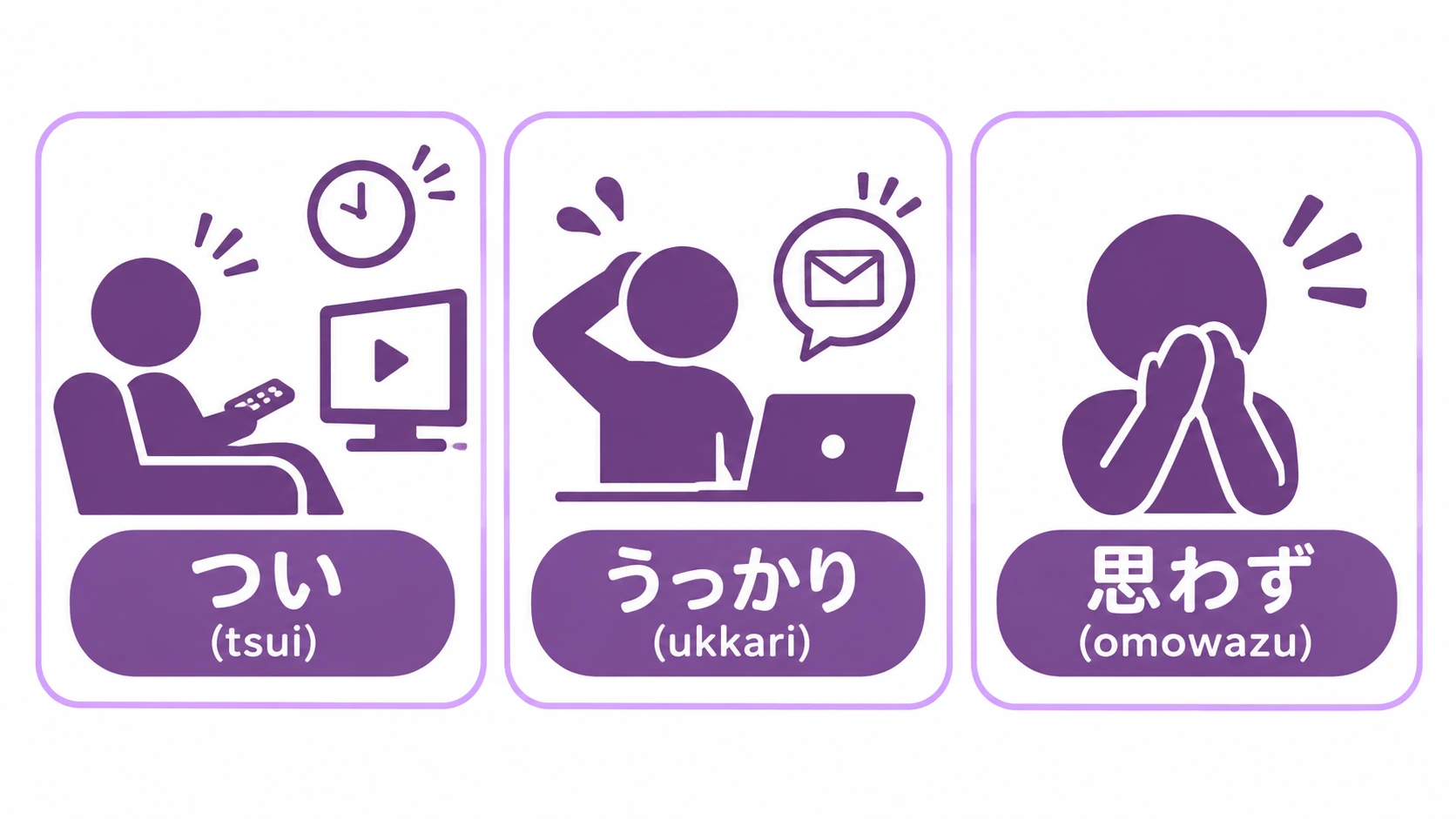
Quick Definition: Tsui, Ukkari and Omowazu
つい often means you got carried away or gave in to an impulse. うっかり points to a careless slip or lapse in attention. 思わず describes a spontaneous reaction, often triggered by surprise, emotion, or something sudden. They can overlap, so context matters.
| Expression | What it emphasizes | A common English rendering |
|---|---|---|
| つい tsui |
You ended up doing something, often because an impulse or temptation was hard to resist. | “I ended up…” / “I couldn’t help…” |
| うっかり ukkari |
A lapse in attention or care caused a slip, oversight, or mistake. | “I accidentally…” / “I forgot to…” |
| 思わず omowazu |
You reacted spontaneously, before consciously deciding what to do. | “Without thinking…” / “Instinctively…” |
Easy way to remember: Tsui = giving in, ukkari = slipping up, and omowazu = reacting instinctively. This is a useful guide rather than an absolute rule.
When to Use Tsui (つい)
つい is common when you did something even though you planned not to, or when a habit or impulse took over. It often goes with eating, shopping, checking your phone, or saying more than you intended.
The action is not necessarily an accident: you may have known what you were doing, but you did not stop yourself. つい〜てしまう or the casual つい〜ちゃう is especially common.
ダイエット中なのに、つい、ケーキを食べてしまった。
Daietto-chuu na noni, tsui, keeki o tabete shimatta.
Even though I’m on a diet, I ended up eating cake.
彼女からの返信が気になって、ついスマホを見てしまいます。
Kanojo kara no henshin ga ki ni natte, tsui sumaho o mite shimaimasu.
I’m waiting for a reply from her, so I keep checking my phone without meaning to.
When to Use Ukkari (うっかり)
うっかり highlights a mistake caused by not paying enough attention. It often appears with forgetting, overlooking a detail, getting a date wrong, or missing your train stop.
Unlike tsui, it does not suggest giving in to temptation. The key idea is that you would probably have avoided the mistake if you had been more careful.
塩を入れるつもりが、うっかり砂糖を入れてしまった。
Shio o ireru tsumori ga, ukkari satou o irete shimatta.
I meant to add salt, but accidentally added sugar.
うっかりして、今日会議があることを忘れていました。
Ukkari shite, kyou kaigi ga aru koto o wasurete imashita.
I forgot I had a meeting today.
When to Use Omowazu (思わず)
思わず is used when something happens so suddenly or feels so strongly that you react before thinking. The reaction might be laughing, crying, shouting, standing up, or turning around.
An omowazu reaction does not have to be a mistake. It can be positive, negative, or simply instinctive.
生まれたばかりの赤ちゃんを見て、思わず笑顔になった。
Umareta bakari no akachan o mite, omowazu egao ni natta.
When I saw the newborn baby, I couldn’t help smiling.
卒業式で、思わず泣いてしまいました。
Sotsugyoushiki de, omowazu naite shimaimashita.
I couldn’t help crying at the graduation ceremony.
Three Natural Conversations
These conversations show how each expression fits naturally into a real situation. Notice what the speaker was trying to do—or what happened before they could think.
1. つい (tsui): One more episode
Situation: Two friends meet for coffee. One of them looks exhausted.
A: 昨日、あのドラマ、1話だけ見るって言ってなかった?
Kinou, ano dorama, ichiwa dake miru tte itte nakatta?
Didn’t you say you were only going to watch one episode last night?
B: そうなんだけど、次の話が始まって、ついそのまま見ちゃって。寝たの、1時。
Sou nan da kedo, tsugi no hanashi ga hajimatte, tsui sono mama michatte. Neta no, ichiji.
Yeah, but the next episode started and I just kept watching. I didn’t get to bed until one.
A: そりゃ眠いわけだ。
Sorya nemui wake da.
No wonder you’re tired.
2. うっかり (ukkari): The missing attachment
Situation: A coworker opens an email before a meeting.
A: さっきのメール、資料が添付されてないみたいです。
Sakki no meeru, shiryou ga tenpu sarete nai mitai desu.
It looks like the document wasn’t attached to your email.
B: すみません、うっかり添付し忘れました。すぐ送り直します。
Sumimasen, ukkari tenpu shiwasuremashita. Sugu okurinaoshimasu.
Sorry, I forgot to attach it. I’ll resend it right away.
A: ありがとうございます。会議までに目を通しておきます。
Arigatou gozaimasu. Kaigi made ni me o tooshite okimasu.
Thanks. I’ll look it over before the meeting.
3. 思わず (omowazu): The last goal
Situation: Two friends are leaving the stadium after a soccer match.
A: 最後のゴール、すごかったね。
Saigo no gooru, sugokatta ne.
That last goal was amazing, wasn’t it?
B: うん。入った瞬間、思わず立ち上がっちゃった。
Un. Haitta shunkan, omowazu tachiagacchatta.
Yeah. The second it went in, I jumped to my feet without thinking.
A: そのあと、隣の人とハイタッチしてたよね。
Sono ato, tonari no hito to haitacchi shiteta yo ne.
And then you high-fived the person next to you.
B: そうそう。初対面だったのにね。
Sou sou. Shotaimen datta noni ne.
I know! We’d never even met before.
Same Action, Different Emphasis
Imagine a coworker makes a joke during a quiet meeting. You laugh even though the situation calls for a straight face. Depending on what you want to emphasize, you might say:
- つい笑っちゃった。 (Tsui waracchatta.) — You tried not to laugh, but could not hold it in.
- うっかり笑っちゃった。 (Ukkari waracchatta.) — You let your guard down and made the mistake of laughing at an inappropriate moment.
- 思わず笑っちゃった。 (Omowazu waracchatta.) — The joke triggered a spontaneous laugh before you could think.
The sentences are not rigid categories. Tsui and omowazu often overlap; the difference is whether you highlight losing control of an impulse or an immediate reaction. Ukkari adds the idea of inattention.
Another example: Letting a secret slip
つい秘密を話しちゃった。
Tsui himitsu o hanashichatta.
I got carried away and ended up telling the secret.
うっかり秘密を話しちゃった。
Ukkari himitsu o hanashichatta.
I accidentally let the secret slip because I wasn’t careful.
Mini Quiz
Choose the word that best conveys the point in bold.
Question 1
You went in just to look, but the jacket was half price and you gave in to the temptation to buy it.
見るだけのつもりだったのに、半額だったから[ ]買っちゃった。
Miru dake no tsumori datta noni, hangaku datta kara [ ] kacchatta.
- うっかり (ukkari)
- つい (tsui)
- 思わず (omowazu)
Show Answer
B. つい. Buying it went against your original plan, but the price was hard to resist.
Question 2
You wrote June where you meant July because you weren’t paying attention.
書類に、[ ]7月のところを6月と書いてしまった。
Shorui ni, [ ] shichigatsu no tokoro o rokugatsu to kaite shimatta.
- うっかり (ukkari)
- 思わず (omowazu)
- つい (tsui)
Show Answer
A. うっかり. The wrong month was a slip you could have caught by checking.
Question 3
You heard a crash behind you and turned around on reflex.
後ろで急に大きな音がして、[ ]振り返った。
Ushiro de kyuu ni ookina oto ga shite, [ ] furikaetta.
- つい (tsui)
- うっかり (ukkari)
- 思わず (omowazu)
Show Answer
C. 思わず. Turning around was an immediate reaction to the sound, not a mistake.
Frequently Asked Questions
Can I use tsui and omowazu interchangeably?
Sometimes. Both can describe an unplanned action, such as laughing. Tsui suggests that you gave in or got carried away; omowazu emphasizes an immediate, spontaneous reaction. The same event can be described from either angle.
Does omowazu always mean something went wrong?
No. You can laugh, smile, cry, or cheer omowazu because of a happy surprise or strong emotion. A mistake is not part of its meaning.
Is つい the same as ついに?
No. ついに (tsui ni) means “finally” or “at last,” as in ついに完成した。 (Tsui ni kansei shita. “It’s finally finished.”) It doesn’t mean the action was unintentional.
Do I need 〜てしまう or 〜ちゃう after these adverbs?
No. うっかり鍵を忘れた。 (Ukkari kagi o wasureta. “I accidentally forgot my keys.”) is complete on its own. 〜てしまう and the casual 〜ちゃう are often used with these expressions to add completion or a sense of regret, but they are not required. See the guide to 〜てしまう and 〜ちゃう.
Practice with Japonin (JOI) Teachers
Understanding these three expressions is a good first step. Using them naturally takes conversation practice.
In Japonin’s live online Japanese lessons, you can talk with Japanese teachers about everyday mistakes, surprises, and experiences—and practice choosing the expression that fits what you mean.
Explore Japonin’s Japanese conversation lessons →
Start with 2 Free Trial Lessons
Japonin Deep Dive / Conversation Japanese
Japonin (JOI) has provided online Japanese lessons since 2006, helping learners around the world build practical communication skills.

Written by Chiho Kamioka Founder
A small word can change what your story emphasizes. With tsui, ukkari, and omowazu, thinking about what caused the action will help you choose more naturally in everyday conversation.