What day is April 8th in the Buddhist calendar ? What do Japanese people do to celebrate this date ? Seyama sensei introduces this interesting topic below and helps to you learn Japanese vocabulary and about Japanese culture. Listen to the YouTube video read by Japonin(JOI)'s staff.
This Japanese teacher’s blog by SEYAMA Shizuka sensei is a great way to study natural Japanese expressions. You can read, listen, and learn useful vocabulary from a short essay written in everyday Japanese.
▶What You’ll Learn
Read Natural Japanese in Context:The Flower Festival
花まつり
4月8日は花まつりです。 みなさんは、「花まつり」と聞いて、何をイメージしますか? 桜の木の下で食事をしたり、お酒を飲んだりするのは、祭りのようですが「花見」ですね。 「花まつり」というのは、釈迦が生まれた日を祝う仏教の祭りです。
日本では、お寺やその近くの幼稚園などに春の草花で作ったお堂をまつります。 甘茶というお茶をお堂の中の仏像にかけたり、みんなで飲んだりして祝います。 甘茶は甘くて苦くて、不思議な味がします。
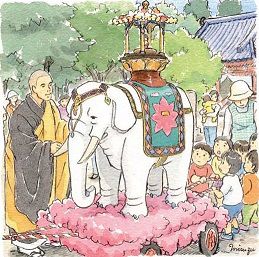
子どもたちは、平安時代の着物を着て、白い象の山車を引いて歩きます。 釈迦のお母さんが妊娠したときに、白い象の夢を見たことから、今でも白い象は縁起のいいものなのです。
わたしも子どものころに白い象の山車を引いたことがあります。 きれいな着物が着られるし、お化粧もできるし、甘茶のキャンディーももらえるので、わたしは花まつりが大好きでした。
最近では、花まつりを見る機会が減ってしまいましたが、大きいお寺へ行けば今でも行われています。機会があれば、行ってみてくださいね。
Learn Japanese Listening with Video Lesson
Watch SEYAMA Shizuka sensei read this blog with clear native pronunciation and improve your Japanese listening skills.
Learn Japanese Kanji with Furigana Reading Help
4月8日は花まつりです。 みなさんは、「花まつり」と聞いて、何をイメージしますか? 桜の木の下で食事をしたり、お酒を飲んだりするのは、祭りのようですが「花見」ですね。 「花まつり」というのは、釈迦が生まれた日を祝う仏教の祭りです。
日本では、お寺やその近くの幼稚園などに春草花ので作ったお堂をまつります。 甘茶というお茶をお堂の中の仏像にかけたり、みんなで飲んだりして祝います。 甘茶は甘くて苦くて、不思議な味がします。
子どもたちは、平安時代の着物を着て、白い象の山車を引いて歩きます。 釈迦のお母さんが妊娠したときに、白い象の夢を見たことから、今でも白い象は縁起のいいものなのです。
わたしも子どものころに白い象の山車を引いたことがあります。 きれいな着物が着られるし、お化粧もできるし、甘茶のキャンディーももらえるので、わたしは花まつりが大好きでした。
最近では、花まつりを見る機会が減ってしまいましたが、大きいお寺へ行けば今でも行われています。 機会があれば、行ってみてくださいね。
English Translation for Understanding
The Flower Festival
April 8th is the Flower Festival day. When you hear 'Flower Festival', what images come to mind ? Eating and drinking sake under the Cherry Blossom trees, sounds like a festival, but this is called 'Hana-mi' or Cherry Blossom-viewing. The 'Hana Matsuri' or Flower Festival is a Buddhist festival celebrating the day that Buddha was born.
In Japan, we enshrine small 'Otou' or shrines made from spring flowering plants in temples and nearby kindergartens. A type of tea called 'Ama cha' is sprinkled over the statue inside the shrine, and drank by everyone in celebration. 'Ama cha' or hydrangea tea has a strange taste that is both sweet and bitter.
Children dress up in Heian period style kimonos and pull around floats of white elephants. When Buddha's mother was pregnant ,it was said that she had a dream of a white elephant, so even today white elephants are seen as good omens.
When I was a child I had the experience of pulling a float of a white elephant before. I used to love the Flower Festival because you got to wear a beautiful kimono, got to wear make-up, and received Ama-cha flavored candy too.
Recently, the opportunities to see the 'Hana Matsuri' are decreasing, but if you go to a large temples they still hold the festival even now . If you have a chance, please go and have a look.
This Week’s Key Vocabulary
祭り festival;feast
花見a cherry blossom-viewing picnic
釈迦Buddha
祝う celebrate
仏教 Buddhism
幼稚園preschool ; infant school ; kindergarten
お堂 Hall ; the place to put image of Buddha
まつる enshrine
甘茶 hydrangea tea
仏像 Image of Buddha
かける squirt ; water ; put
苦い bitter
不思議 wonder; strange ; mysterious
平安時代 Heian Period(794-1185)
山車 float ; dashi
妊娠 pregnancy
縁起 omen ; lucky
化粧 makeup
機会 chance ; opportunity
Meet the Teacher

Japanese Language Teacher
Join a live Japanese class and start learning with our teachers today!