


Japanese Conversation Expressions: Meaning, Nuance & Natural Usage
Learn how common Japanese expressions really work in everyday conversation.
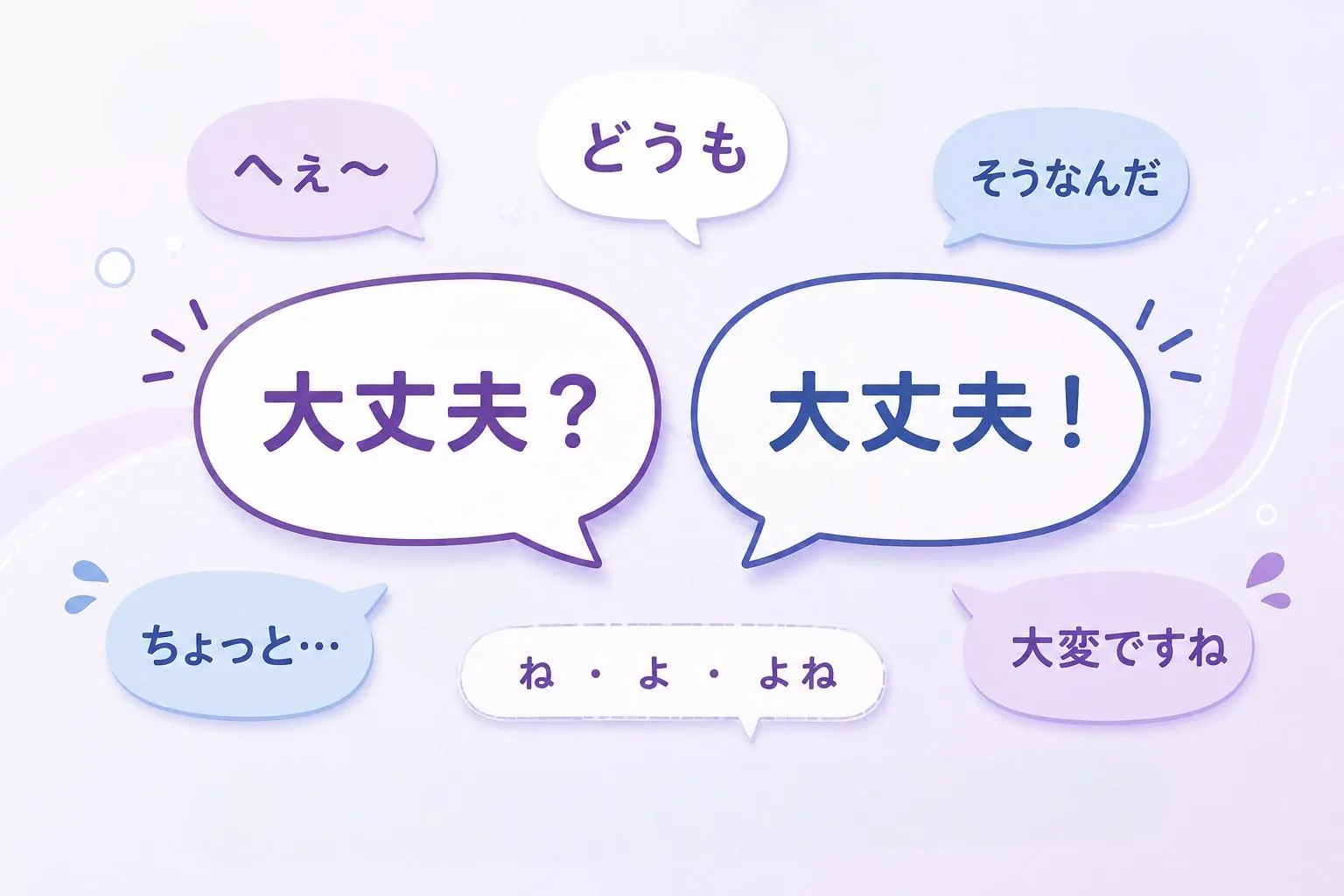
Japanese expressions can look simple, but what they really mean often depends on the situation. Daijoubu, for example, can mean “I'm fine,” “It's okay,” or even “No, thank you.”
This guide brings together Japonin's Deep Dive articles on common conversation expressions, so you can understand not just their dictionary meanings, but how they actually work in real Japanese.
Everyday Reactions & Responses
These four guides cover some of the most common reactions and responses in everyday Japanese, from flexible expressions like doumo and daijoubu to natural listening reactions and expressions of empathy.
Dōmo (どうも)
Why can doumo mean “thanks,” “hello,” or simply add emphasis? Learn how context and tone change this highly flexible expression.
Dōmo meaning and usage →Aizuchi: Natural Listening Reactions
Learn reactions such as へぇ〜, そっか〜, and そうなんだ that show interest and keep Japanese conversation flowing naturally.
Learn Japanese aizuchi →What Does 大丈夫 (Daijoubu) Mean?
Daijoubu can mean “I'm fine,” “It's okay,” “No problem,” or even “No, thank you.” Learn how to identify the intended meaning from context.
Understand daijoubu →Taihen (大変 / たいへん)
Learn how taihen can mean “difficult,” “serious,” “Oh no!,” or “very,” and how 大変ですね is used to show empathy.
Explore taihen →Polite Refusals & Softening
Japanese speakers often avoid a direct “no,” especially when they want to keep the conversation polite or smooth. Start with these two guides to see how refusals are softened in Japanese, and why expressions that sound polite can still feel different depending on context and tone.
How to Say No Politely: The Soft NO
Learn why Japanese speakers often avoid saying いいえ directly and how expressions such as ちょっと… can communicate a polite refusal.
Learn the Japanese Soft NO →結構です (Kekkou Desu)
Kekkou desu can mean “No, thank you” or “That's enough,” but it can sound firmer than learners expect. Learn when it works and when a softer expression may be better.
Learn how to use kekkou desu →Nuance & Conversation Flow
Some of the hardest parts of Japanese are not about grammar itself, but about how speakers show attitude, shared understanding, and conversational intent. These two guides look at how subtle choices can change the flow and nuance of a conversation.
How to Use ね・よ・よね Naturally
See how ね, よ, and よね change the feeling of a sentence by sharing information, adding emphasis, or checking agreement.
Compare ね・よ・よね →一応 (Ichiou) vs. とりあえず (Toriaezu)
Both expressions can be difficult to translate directly. Learn how ichiou and toriaezu differ in intention, confidence, and conversational nuance.
Compare ichiou and toriaezu →Which Japanese Conversation Guide Should You Read?
Use this quick guide to find the expression that matches what you want to understand or do in conversation.
| If you want to... | Start with... |
|---|---|
| React naturally while listening | Aizuchi |
| Understand an expression that can mean yes or no | Daijoubu |
| Show empathy or react to a difficult situation | Taihen |
| Say no without sounding too direct | Soft NO |
| Understand why a refusal can sound firm | Kekkou desu |
| Make your sentence endings sound more natural | ね・よ・よね |
| Understand subtle differences between everyday words | Ichiou vs. Toriaezu |
| Understand a highly flexible everyday expression | Dōmo |
Since 2006, Japonin (JOI) has provided online Japanese lessons to over 6,000 learners worldwide, guided by our team of qualified and experienced teachers.

Written by Chiho Kamioka Founder
In this Japonin Deep Dive collection, we explore how common Japanese conversation expressions work beyond their dictionary meanings. Understanding context, tone, and subtle differences in nuance can help learners follow real Japanese more naturally and choose expressions that fit the situation.
Ready to improve your Japanese?
Try two 50-minute live Japanese lessons with Japonin teachers.
Build confidence in everyday Japanese conversation with guidance and real feedback.